Our article in brief
- In a small bathroom 3m2, The material matters more than the centimeters: everything is within reach and sight, so everything is visible.
- The surfaces continues — tadelakt, terrazzo, light-colored stone — soothe the eye; small enameled formats like zellige tiles, they make the light vibrate.
- A consistent color from floor to ceiling makes a room appear larger than white divided into thirds. dark tones are not forbidden: they transform a windowless room into a jewel box.
- THE mirror is the cheapest and most effective enlargement tool, provided you are large and well positioned facing the light.
- This falls outside the 3 m² category of "technical cupboard": invisible storage, two beautiful materials, a thick textile and a plant.
Three square meters is the size of a large hallway rug. It's also, in many apartments, all the space you have to wash, comb your hair, and breathe for five minutes before the day begins. And it's often the room that gets done last: white, neutral tiles, "we'll see later." I think that's a shame, because a small bathroom of 3m2 This is precisely where the material is most visible.
In a large space, a beautiful wall gets lost in the background. Here, nothing gets lost: you brush your teeth against the zellige tiles, you can feel the texture of the tadelakt in the steam, the brass warms to the touch. This notebook isn't a work plan—it's a guide to materials, colors and light, so that your 3 m² cease to be a technical closet and become a place where you want to hang out a little.
This makes a 3 m² bathroom really pleasant
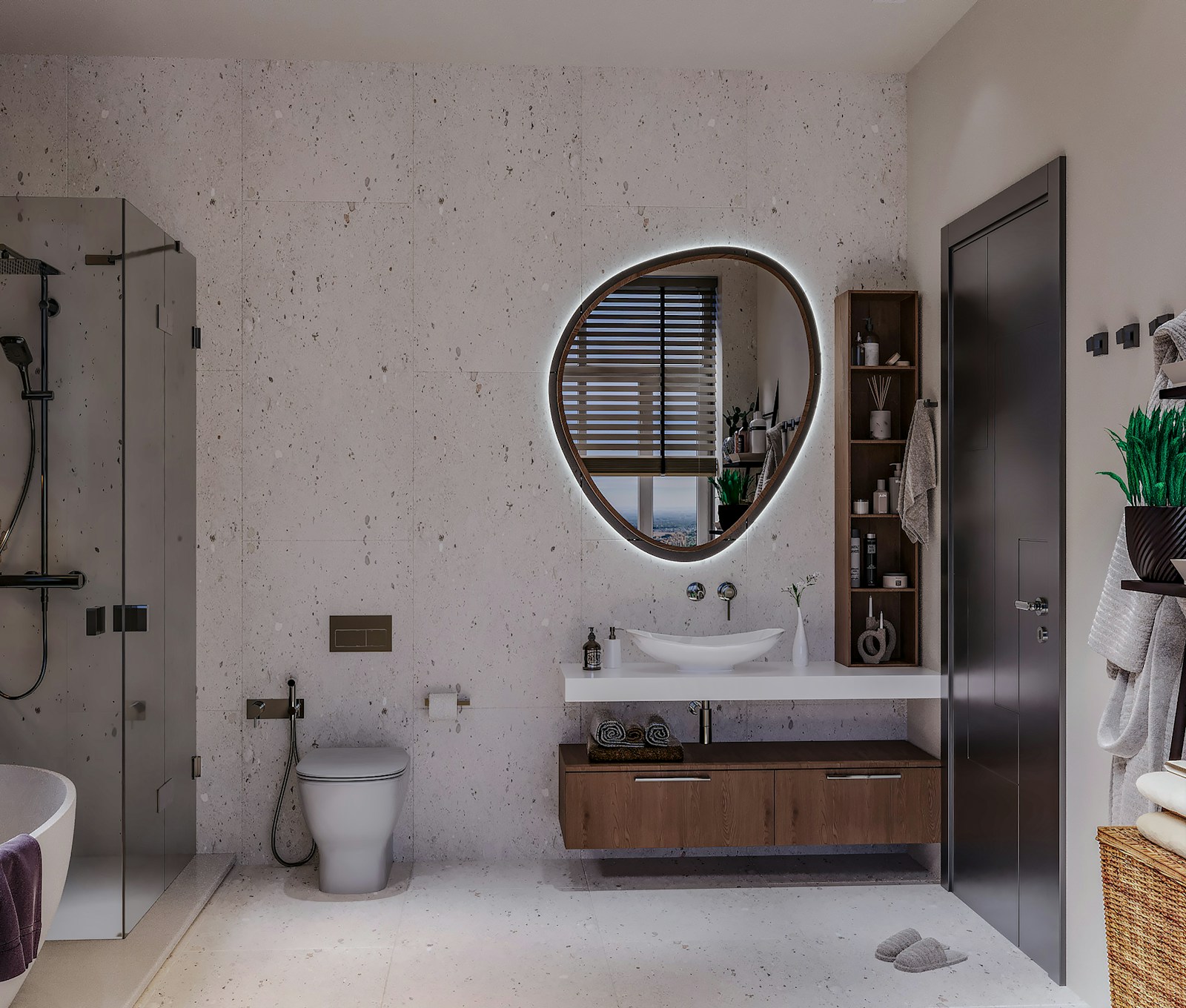
A small bathroom becomes pleasant when the eye can move freely without being stopped: few breaks in the flooring, continuous surfaces, a consistent color from floor to ceiling, and warm lighting. What tires the eye in 3 square meters is not the size itself—it's the accumulation of small contrasts and conflicting materials.
Three square meters, you feel it before you measure it
Step into a tiny bathroom and try this exercise: where does your gaze land? Almost always on an edge, a baseboard, a darker grout line, a corner of a piece of furniture. In a large room, these micro-breaks go unnoticed. In 3 square meters, they become the focal point. This is why two bathrooms of identical size can produce opposite sensations: one choppy, the other surprisingly calm.
What really matters is the number of different materials visible at a glance. Two, and the room breathes. Five, and it closes in. I've gotten into the habit of thinking in terms of duos A dominant material that covers the floor and part of the walls, a warm material that punctuates the space — and that's all. The rest is accepted as is: the towels, the toothbrush holder, a plant, will be enough to bring the whole thing to life.
Bathroom or shower room: how the word changes the atmosphere
We search for "3m2 bathroom" and we almost always fit out a bathroom A shower room, not a bathtub. This isn't just a matter of vocabulary. A bathtub imposes a long horizontal mass, a rim, a panel—three strong lines in a room that can accommodate few others. A shower, on the other hand, can disappear into the extension of the floor.
Accepting the term "bathroom" means embracing a more fluid, almost Japanese aesthetic: water, stone, a bench, few objects. The Sunday bath is lost; instead, a room resembles a small, private hammam rather than a technical space squeezed between two doors.
Square or rectangular: what the plan changes when viewed
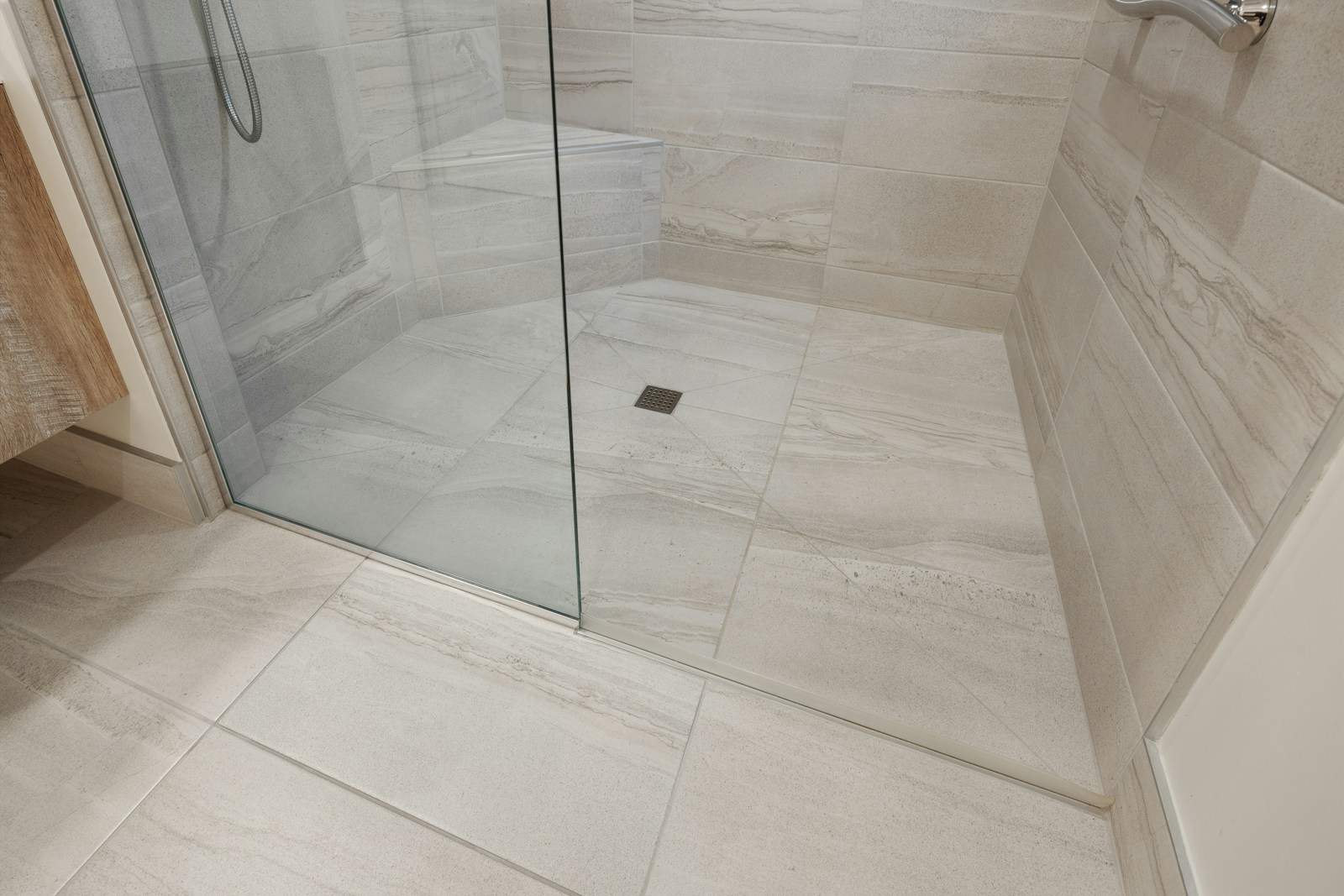
The 3 square meters take on two forms. The square, Approximately 1.70 m square, it offers three roughly equal sections: the eye rotates, no single wall dominates, and the room can accommodate an accent wall—a shower enclosure tiled in zellige, for example.’lengthwise, A corridor-type layout, on the contrary, creates a perspective: the gaze travels straight towards the end. This is advantageous, provided that the eye is given something to look at at the end rather than a cabin door.
In a long, narrow room, I therefore place the most beautiful material at the bottom And I keep the sides simple. In a square, I do the opposite: one wall is tiled, the others are plain. For anything related to exact dimensions, moving a drain, electricity and ventilation, we're outside the realm of decoration: these points must be confirmed with a professional before buying a single tile.
In video: "Optimizing a small bathroom of 3.8 m2" (atelier a storia) — useful to see how the view opens up when the volumes are rethought.
Materials that give soul to 3 m²
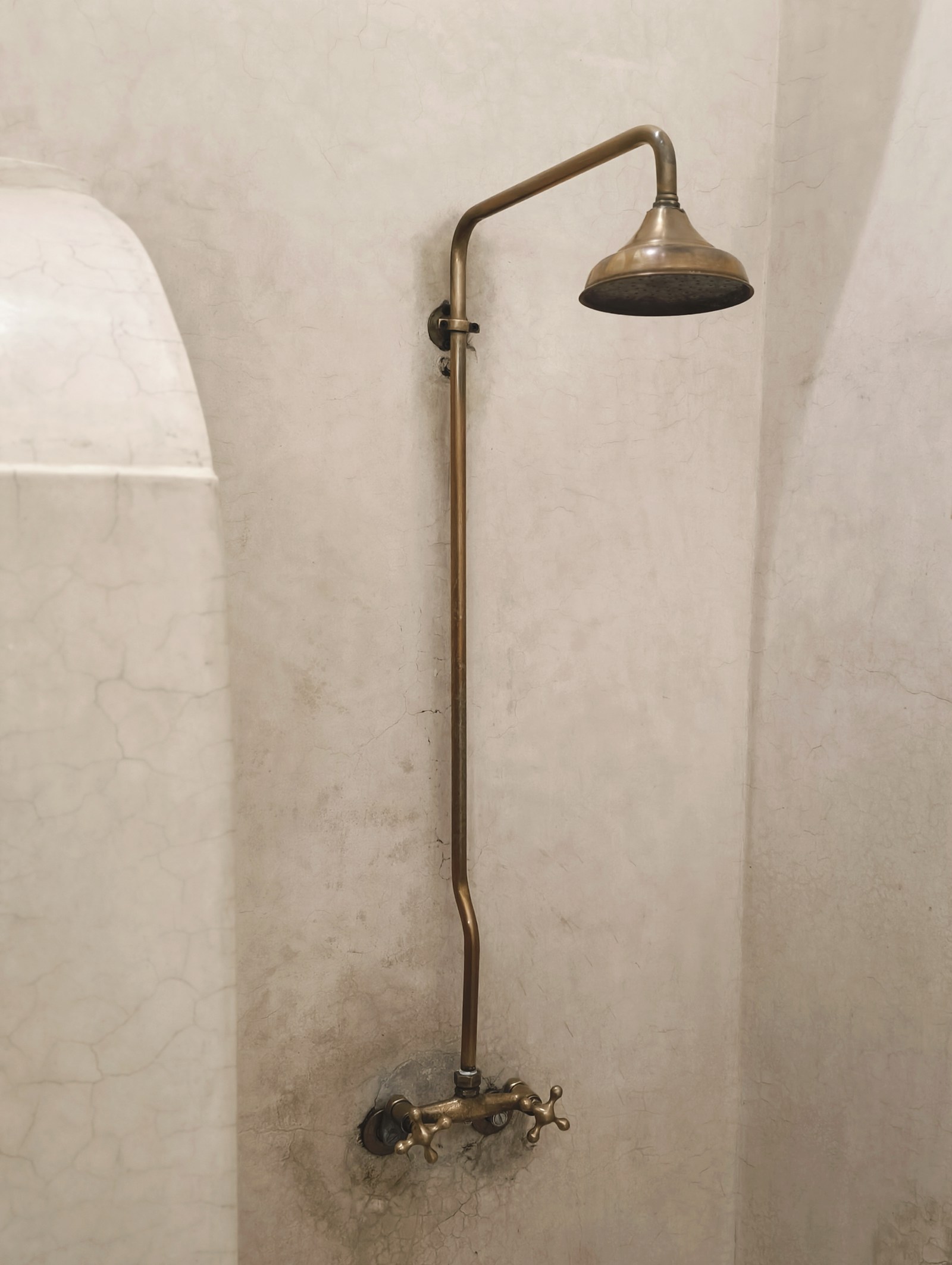
In a 3-square-meter bathroom, every material is seen up close, touched daily, and exposed to steam. It makes sense to choose two or three that age well and tell a story: lime plaster, handmade ceramic, smooth stone, oiled wood. This is where the small size becomes an advantage, because beautiful materials cost less in square footage than elsewhere.
Tadelakt and lime plasters: a single, continuous wall
THE tadelakt Tadelakt is a lime plaster of Moroccan origin, long reserved for hammams, polished with stone and then soaped to become waterproof. Its appeal in a 3 m² space is primarily visual: it eliminates grout lines. A shower wall finished in tadelakt is no longer a grid; it's a single, slightly hazy surface that catches the light like a second skin. The eye no longer has to count, and the room instantly feels calmer.
It's a craftsman's touch: the material is squeezed at the right moment, smoothed without burning, and the result depends entirely on the hand. Therefore, it's best left to someone experienced in this technique, or you can opt for a decorative plaster of a similar type. mineral concrete for a seamless effect that is easier to achieve. This spirit of a smooth surface and earthy tones is at the heart of the Mediterranean style decor, of which the bathroom is often the finest example.
Zellige, terrazzo, stone: the small format that doesn't make the room feel smaller
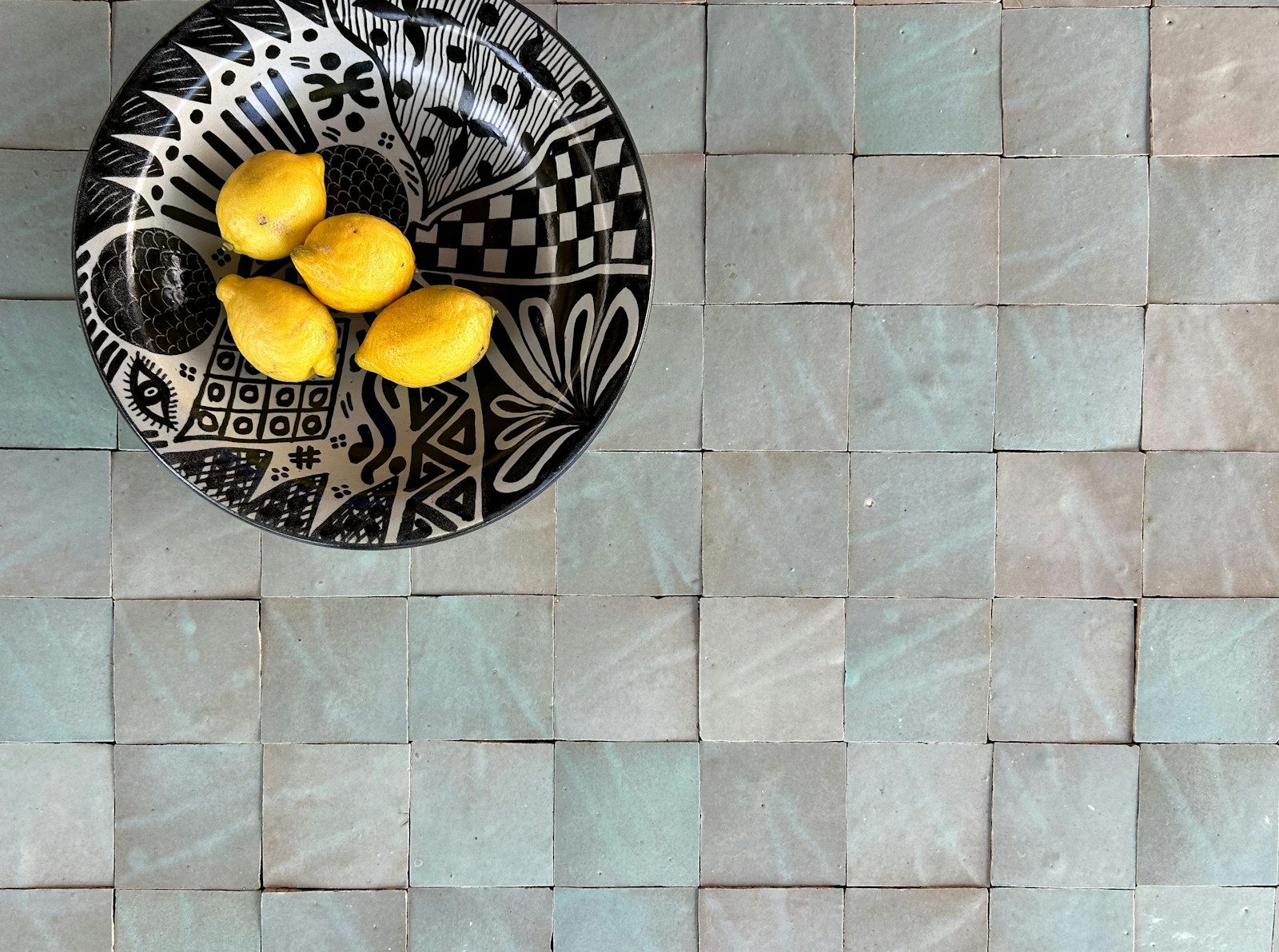
It's often said that you need large format tiles in a small room. That's true for matte industrial tiles, whose dark grout lines create a grid. But that becomes false with... zellige, These small, hand-shaped glazed earthenware tiles from Morocco, with their irregular edges and domed glaze, reflect light in all directions. The unexpected result—the wall loses its legible dimensions; it shimmers. This expertise falls under the craft of the ceramist, which...’Institute for French Know-How It is listed among the crafts.
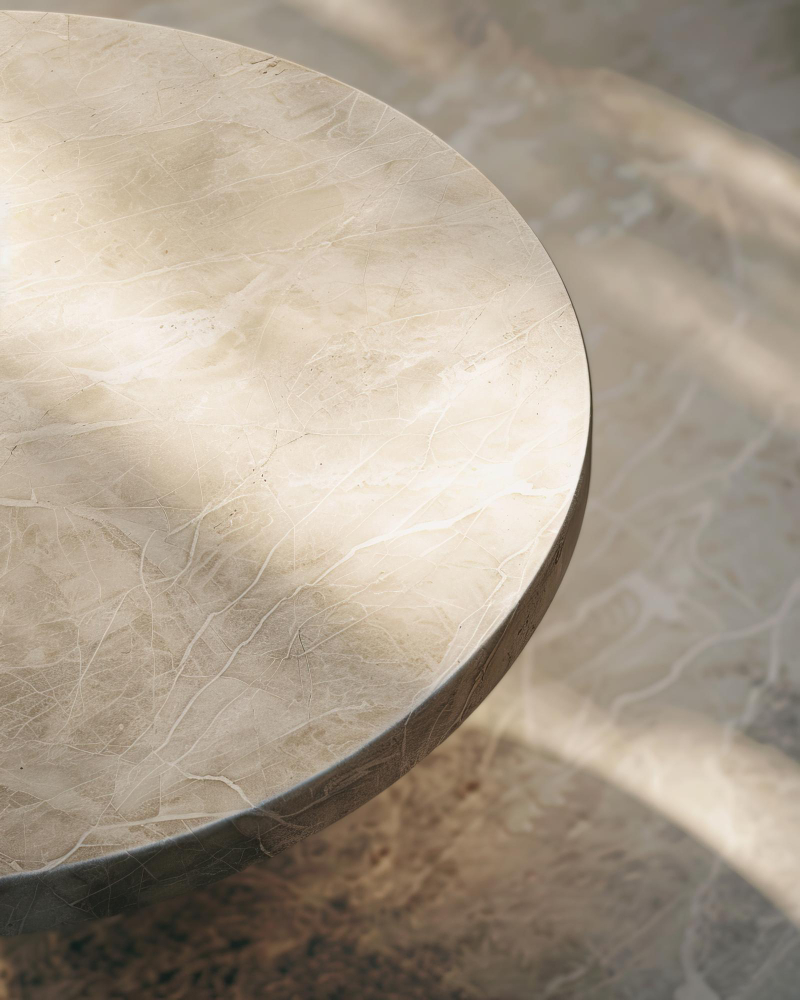
THE terrazzo plays another card: shards of marble or glass set in a light binder, inherited from the gesture of mosaicist, which cuts and assembles marble, sandstone, and glass paste. It adds color without painting an entire wall, which is invaluable when you only have 3 square meters. A tip: choose thin shards. Large confetti pieces, which look very graphic in photos, quickly add visual interest to a small space. When using stone, stick to light, warm tones—travertine, beige limestone—which warm up artificial light instead of making it appear green.
Wood and brass: the two warm notes of a bathroom
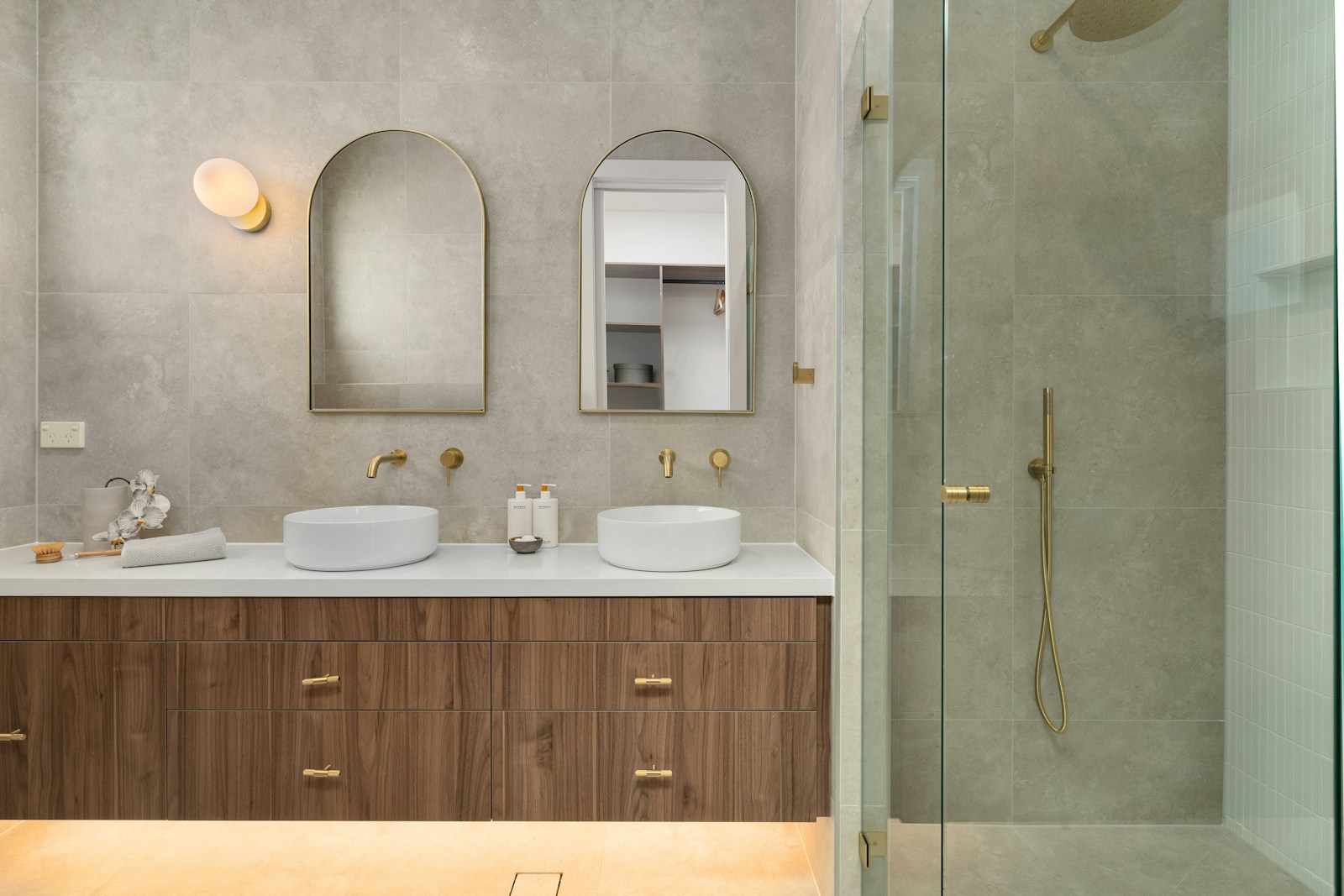
A bathroom lined entirely with minerals can become cold. Two materials are enough to remedy this. The drink First — teak, oiled oak, water-repellent woods — on a vanity unit, a shelf, or a slatted floor covering: it brings back the grain, the honey color, the warm touch of the morning. It is simply kept out of areas of direct splashing and oiled from time to time, like a worktop.
THE brass Then, brushed or aged: faucets, hooks, handles, mirror frames. A tiny room only needs three or four warm reflections to change the atmosphere, and brass provides them without taking up an inch. It develops a patina, it darkens, it retains fingerprints—exactly what's needed. If you choose a washbasin as a statement piece, our guide to designer countertop washbasins helps to harmonize its material with the rest.
| Matter | What changes in 3 m² | Where to put it | Namely |
|---|---|---|---|
| Tadelakt | Seamless surface: the wall becomes a single plane, the room feels calmer. | Shower wall, entire walls, vanity top | It is applied and polished by hand; it should be entrusted to a craftsman who practices it. |
| Enameled zellige | It makes the light vibrate; the wall loses its legible dimension | A single wall, shower backsplash, washbasin backsplash | Deliberate irregularities: that's what makes it so charming |
| Terrazzo | Adding splashes of color, without painting an entire wall | Floor, washbasin shelf, baseboard | Prefer thin shards in a small room |
| Light-colored stone (travertine, limestone) | Soft matte finish and warm tint that enhances the lighting | Floor, shelf, shower bench | Requires a water-repellent treatment and gentle maintenance. |
| Water-repellent wood (teak, oiled oak) | Takes the item out of the health register, brings the grain | Vanity unit, shelf, grating | Keep away from direct splashes, and oil regularly. |
| Brushed or aged brass | Three warm reflections are enough to warm up a light-colored room. | Faucets, handles, mirror frame, coat hooks | It develops a patina over time: accept it or polish it. |
In 3 square meters, you don't make the room look bigger: you declutter the view. Two beautiful, well-maintained materials do more than pushing back a wall.
Colors and light in a room that is often windowless
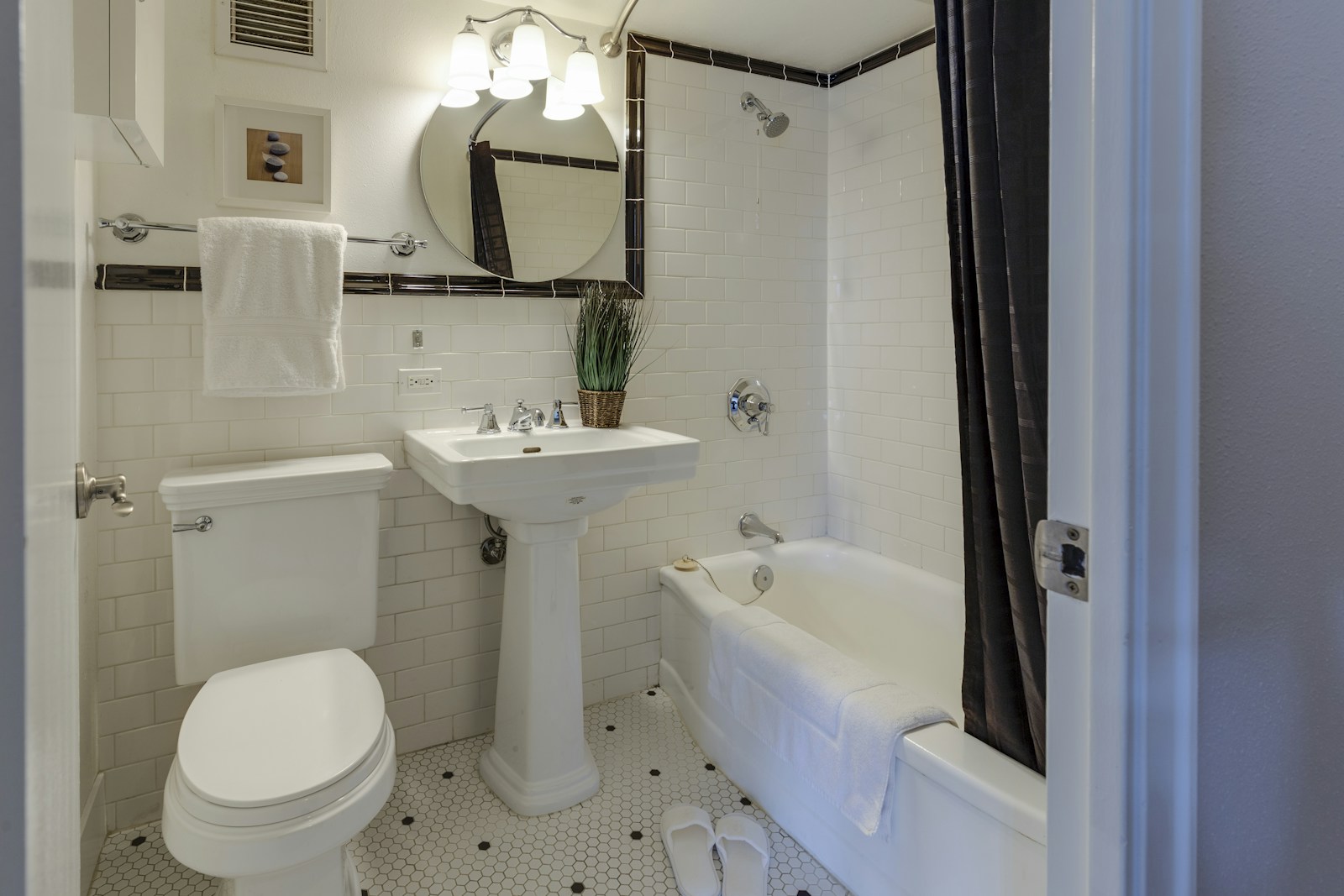
Most 3-square-meter bathrooms don't have a window. Therefore, color isn't used to play with sunlight, but to decide what kind of light you want to be surrounded by in the morning. A warm, slightly muted shade holds up better under a lamp than pure white, which looks gray as soon as the light dims.
What color for a small bathroom without a window?
Without daylight, very cool whites turn into a clinical gray. I recommend instead... clear warm Creamy off-white, eggshell, sand, rosy ivory, pale clay. They retain their color under a light bulb and are forgiving of steam. The other rule is more important than the choice of shade itself: the hold. Use the same color on the walls and ceiling, and a similar flooring color, and the room ceases to be a jumble of horizontal stripes. It's the most effective—and cheapest—trick to make a room appear larger.
- Warm lights — Off-white, sand, ivory: the safe bet, provided you avoid bluish whites.
- Soft soils — clay, pale terracotta, broken ochre: warm, very beautiful under dim light.
- Greens and grayish blues — sage, eucalyptus, flax blue: soothing, they work well with brass.
- Deep hues — cocoa brown, dark green, brick: best reserved for the total look, including the ceiling.
Are dark colors really forbidden in 3 square meters?
No, and it's actually one of the most beautiful gambles you can take on a windowless room. A small, dark bathroom doesn't pretend to be large: it becomes a case. Cocoa brown, forest green, brick—the shade we love at La Maison Coloniale—soften the angles instead of emphasizing them. Lacking reference points, the eye no longer measures the room; it simply finds it enveloping.
Two conditions, however. The color must extend to the ceiling, otherwise the darkness will be overwhelming. And the lighting must be more generous than elsewhere, with low, warm sources that make the faucets gleam. This is where the brass, the mirror, and an ecru towel truly come into their own: they become the only bright points in the composition. Our guidelines for trending colors 2026 provide color combinations that can be directly transposed here.
Use accent lighting rather than a ceiling light.
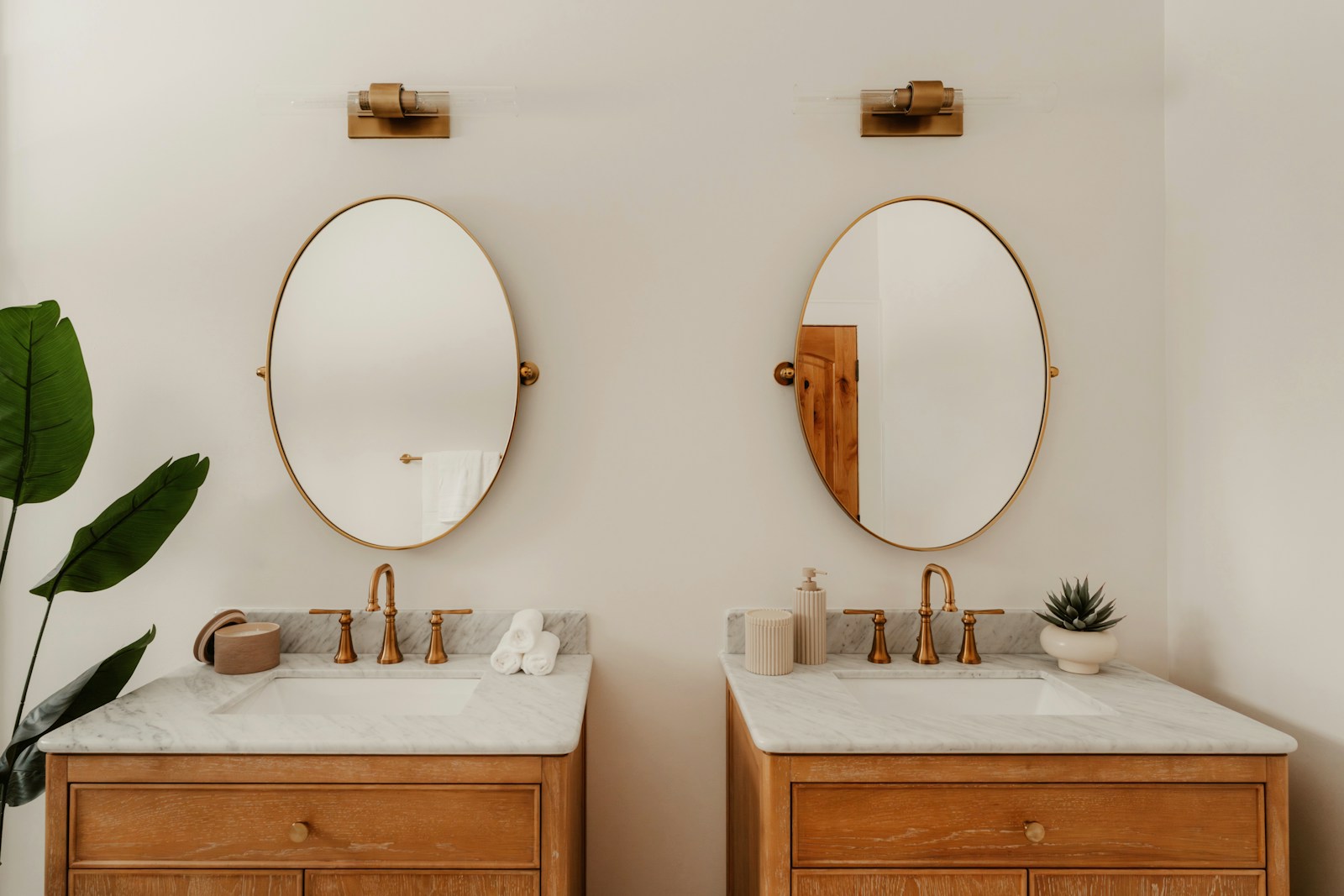
A single ceiling light in the center of a 3 m² room creates two things nobody wants: shadows under the eyes in front of the mirror and dark corners. The solution lies in one word: multiply. Soft ceiling light for circulation, two points on either side of the mirror at face level, and if possible low lighting — strip light under the furniture, wall light near the floor — for nighttime comings and goings.
In terms of ambiance, a warm light flatters skin, wood, and plasterwork; a more neutral light remains useful above the mirror for shaving or applying makeup. A mix of both is ideal. However, the entire electrical installation in a bathroom must adhere to specific requirements depending on its location: it's a electrician which validates the light points and sockets, not a decorative item.
The mirror, the most underestimated magnifier
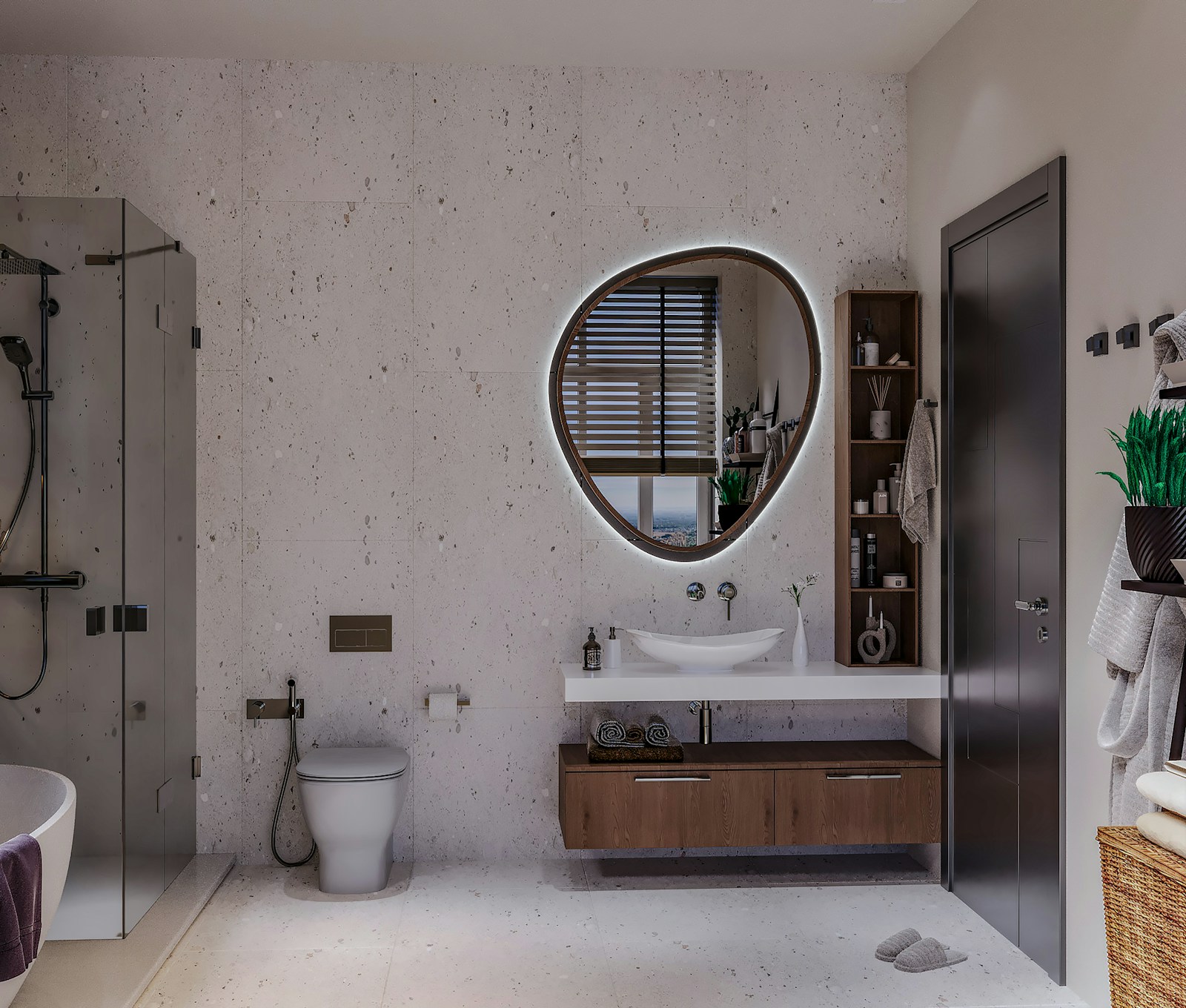
No other element makes such a difference in a tiny bathroom. A mirror doesn't take up any floor space, it reflects existing light, it complements a favorite material, and it creates a false sense of depth where there's only a wall. In a 3-square-meter space, it's the most cost-effective feature of the entire project—and often the most timidly implemented.
What size mirror is needed in a small bathroom?
Bigger than you think. The small 40cm mirror placed above the sink is the most counterproductive reflex imaginable: it reflects almost nothing and emphasizes the narrowness of the vanity. Aim for at least the full width of the washbasin area, and don't hesitate to go up high, until you cover a good part of the wall section.
In a long, narrow room, a mirror spanning an entire side wall literally doubles the length of the hallway. In a square room, a large circle is softer: it breaks up the surrounding geometry and softens the edges. And if your room includes a toilet, the same reasoning applies to its wall—our ideas for modern toilet decoration They show how a mirror and a beautiful shade are enough to treat this corner with elegance.
Where to place it, and what frame to choose
A mirror is only as good as what it reflects. Before drilling, hold it at arm's length and look at the image: if it reflects the door, the trash can, or the washing machine hose, move it. If it reflects the light, the zellige tile wall, or the plant placed high up, you've found it. The frame, He decides on the style: brass for warmth, limed wood for softness, arch for a more handcrafted design, no frame at all to disappear.
- Facing the light source — window, interior skylight or wall sconce: the mirror redistributes the light.
- On the longest wall from a room to a corridor, to visually widen the passage.
- Never facing the door From the start: we are then reflecting the disorder of the corridor, not the room.
- One large room rather than three small mirrors, which redefine the wall.
💡 Alex's Tip — Take a photo of your bathroom with your phone, then convert the image to black and white. Disparities in color will be immediately apparent: a floor that's too dark, a baseboard that cuts in, a piece of furniture that clashes. It's the quickest way to determine what to unify before buying anything.
Discreet storage: out of the technical closet
What transforms a bathroom into a utility room is almost never the size: it's the visible clutter. Mismatched bottles, brushes, plastic containers placed on the edge. In 3 square meters, there's no dead space that the eye doesn't wander to. Tidying up thus becomes a decorative act in its own right—and the real question is less "where to put things" than "what to hide.".
Storage without furniture: niche, narrow column, high shelf
The rule I apply: everything placed on the ground must be justified. One niche A recessed shelf, carved into the shower wall and lined with the same plaster or tile, replaces suction cup shelves without adding anything to the room. narrow column A cabinet that reaches the ceiling stores a great deal of space in a very small area, especially if its front matches the wall color and blends in. And the strip of wall above the door, almost always wasted space, is perfect for a shelf for clean towels.
- A niche in the shower, with the same coating as the wall: invisible and indestructible.
- A storage mirror shallow: two functions, zero centimeters taken from the ground.
- A thin column tone on tone, all the way to the ceiling, for everything that shouldn't be seen.
- Brass coat hooks rather than a bulky towel warmer if space is really limited.
Textiles, baskets, a plant: these are the things that make you want to stay.
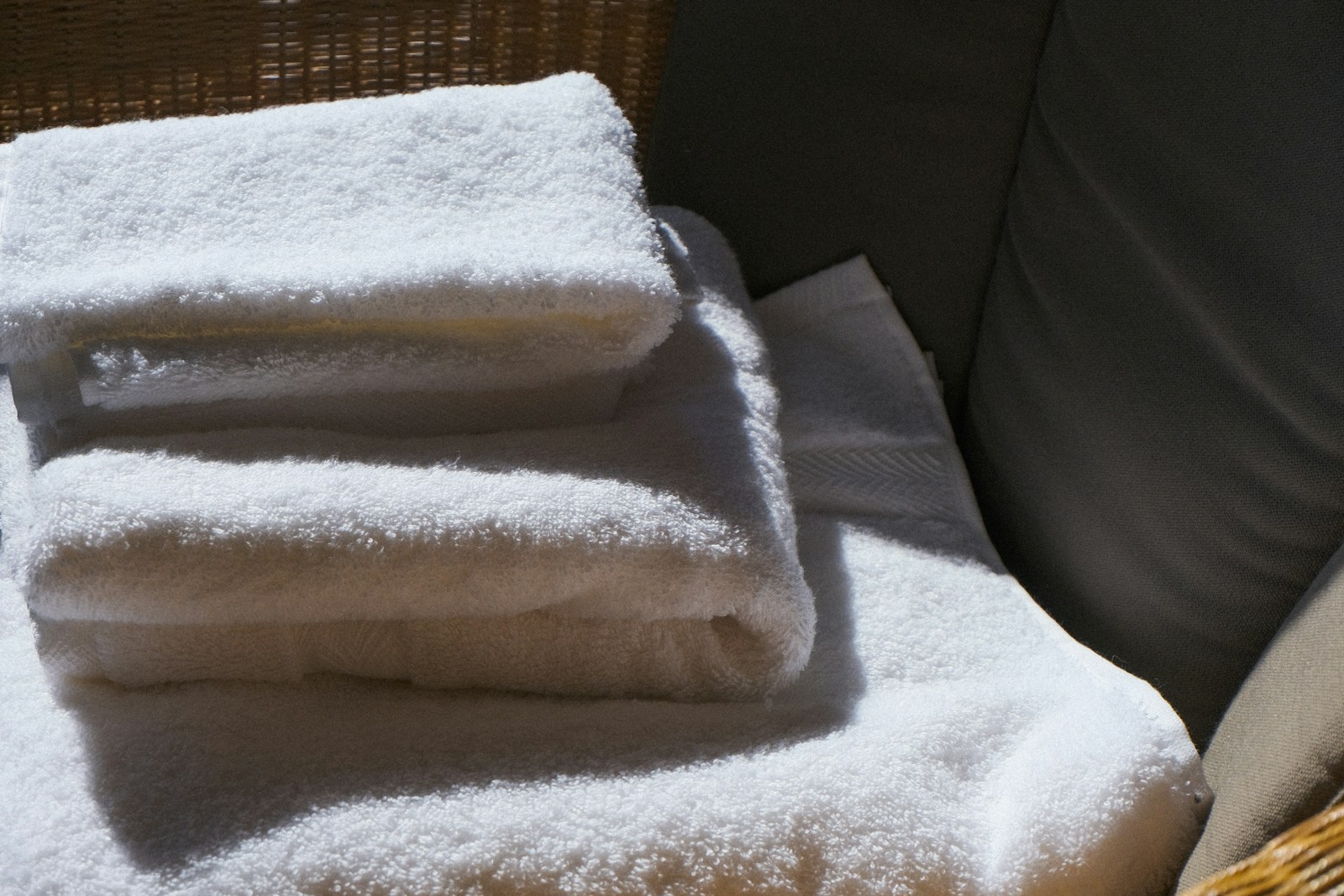
Once the materials and storage are in place, the most enjoyable part remains: the objects we choose to leave visible because they are beautiful. Two linen napkins or waffle-weave cotton, in a shade close to the wall, softens a stark room better than a patterned rug. A rattan or rush basket for dirty laundry, a wooden tray holding three bottles, soap in a terracotta dish: these are the living materials that transform a bathroom into a haven of lifestyle.
Add a plant. Humidity and indirect light suit many indoor tropicals, and green is the color most often missed in a wet room. Finally, such a small room quickly becomes saturated with humidity: a efficient ventilation, This treatment, which should be checked by a professional, is what provides lasting protection for your plaster, wood, and textiles. It's less romantic than zellige tiles, but it's what allows everything else to age well.
Want to turn your ideas into a project?
Read our guide to renovating your bathroomFAQ: Small bathroom of 3 m²
How to furnish a small bathroom of 3m2?
Limit yourself to two or three materials, maintain a consistent color from floor to ceiling, and eliminate visual breaks on the floor. Add a large mirror facing the light, closed or built-in storage, and two warm accents like wood and brass to avoid a cramped, technical feel.
What color for a small bathroom without a window?
Opt for warm, light colors—creamy off-white, sand, ivory, pale clay—which retain their natural hue under a lamp, whereas bluish whites tend to appear grayish. Apply the same shade to the walls and ceiling: this continuity makes the room appear larger than the color choice itself.
What color tiles are suitable for a small bathroom?
Choose tiles in a color close to that of the walls, with grout in a very similar shade: it's contrasting grout that makes a room appear smaller, not the tile size. Glazed zellige is an exception, as its irregular sheen obscures the perception of dimensions.
How to furnish a 3m2 long bathroom?
Embrace perspective rather than fight it: keep the side walls simple and place the most beautiful materials at the far end, where the eye naturally falls. A full-length mirror on one side visually widens the passageway, and a continuous floor prevents the room from feeling divided into sections.
How to give a modern style to a small 3m2 bathroom?
Opt for continuity: seamless mineral plaster or tadelakt, a single-layer floor, and matching wall-mounted furniture. Add brushed brass or matte black faucets, a large frameless mirror, and multi-point lighting rather than a single ceiling light.
How to furnish a 3m2 bathroom under a sloping ceiling?
Treat the slope like an alcove rather than a constraint: a single color applied from the wall to the sloping ceiling eliminates the break and makes the space appear larger. Reserve the lower section for storage, and illuminate the sloping ceiling from below to reveal its texture.