Permeable concrete is an exterior surface designed to allow rainwater to infiltrate directly into the ground. It is often used for patios, driveways, and parking areas to minimize puddles and improve natural water drainage. Before making your choice, it is essential to thoroughly understand its advantages, limitations, and conditions of use.
Understanding the principle of permeable concrete
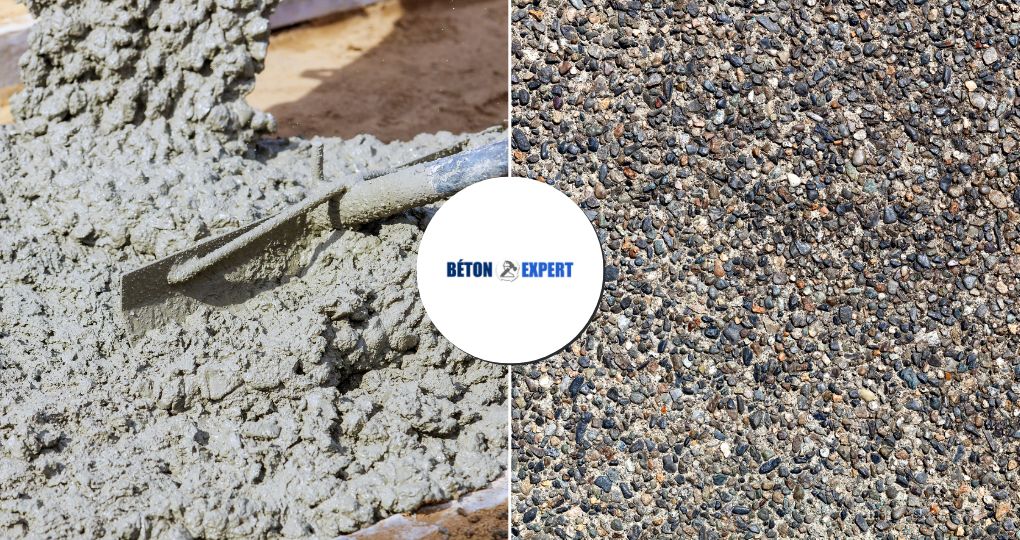
Porous concrete differs from conventional concrete in its composition. It primarily contains aggregates and cement, but very few fine particles. This structure creates voids within the material, allowing water to circulate through the slab.
When rain falls, the water doesn't remain on the surface. It passes through the concrete, through a gravel foundation layer, and then infiltrates into the natural soil. This process significantly reduces runoff.
For the system to function correctly, several conditions must be met:
- The soil must have a minimum absorption capacity
- A drainage foundation layer must be installed
- The thickness of the slab must be adapted to its intended use.
If any of these elements are neglected, performance can be compromised. Therefore, permeable concrete is not just a material, but a complete system whose effectiveness depends on the quality of its installation.
The tangible benefits of permeable concrete
The main advantage of permeable concrete lies in its ability to manage water naturally. In residential areas, this provides immediate comfort.
Effective rainwater management
By eliminating puddles, it improves the safety and accessibility of outdoor spaces. After heavy rain, the surface remains usable much more quickly than traditional concrete.
The benefits are clear:
- Fewer slips due to standing water
- Reduction of runoff into the road
- Reduced risk of water seeping into adjacent walls
In an urban context, this solution also helps to limit the overloading of drainage networks.
Safety and ease of use
The texture of the permeable concrete is slightly rough. This characteristic improves grip, even when the surface is wet.
It is particularly suitable for:
- The pool beaches
- Footpaths
- House entrances
For a family with children or elderly people, this aspect can make all the difference.
Aesthetic integration
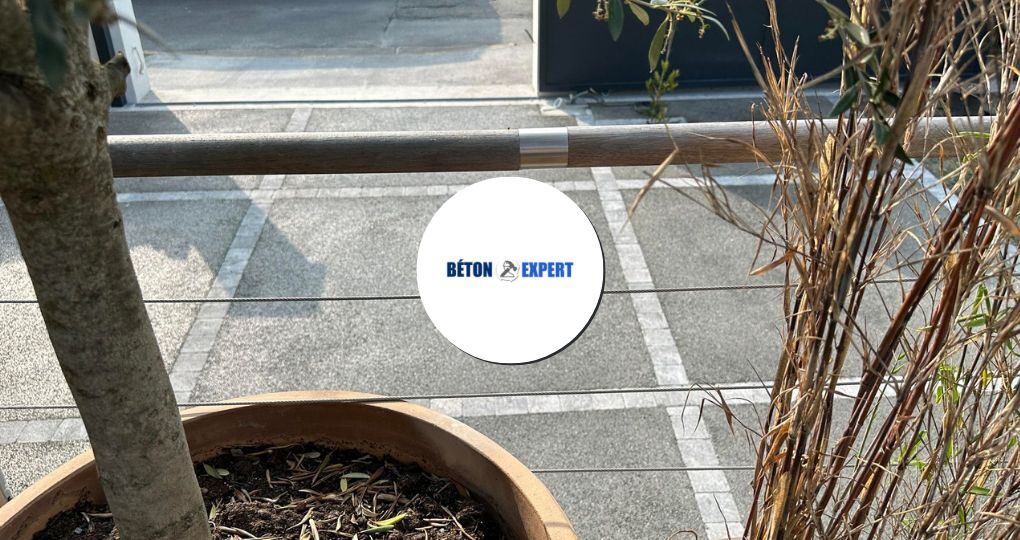
Contrary to some common misconceptions, permeable concrete It can offer a neat finish. It has a natural, discreet, and modern mineral appearance.
It can be easily integrated into:
- A contemporary landscaping design
- A terrace with clean lines
- A simple residential courtyard
Its appearance remains consistent and enhances the entire outdoor space.
Contribution to improved thermal comfort
Thanks to its permeability, permeable concrete can limit excessive heat buildup on the surface. The infiltrated water contributes to slight thermal regulation.
On large areas exposed to the sun, this feature can improve user comfort in hot weather.
Limitations and constraints to consider
Despite its qualities, permeable concrete has weaknesses that should not be ignored.
More limited mechanical resistance
Its porous structure makes it less compact than traditional concrete. It is less able to withstand very heavy or repeated loads.
It is not recommended for:
- Industrial zones
- Parking lots accommodating heavy vehicles
- Surfaces subjected to high mechanical stress
For typical residential use, it remains suitable, but the slab thickness must be correctly sized.
Susceptibility to clogging
Over time, the pores can become clogged with fine particles. If maintenance is neglected, the drainage capacity gradually decreases.
The main causes are:
- Dust accumulation
- Plant deposits
- Lack of regular cleaning
Simple maintenance, such as cleaning with water or moderate pressure, helps to preserve its performance.
Implementation requirement
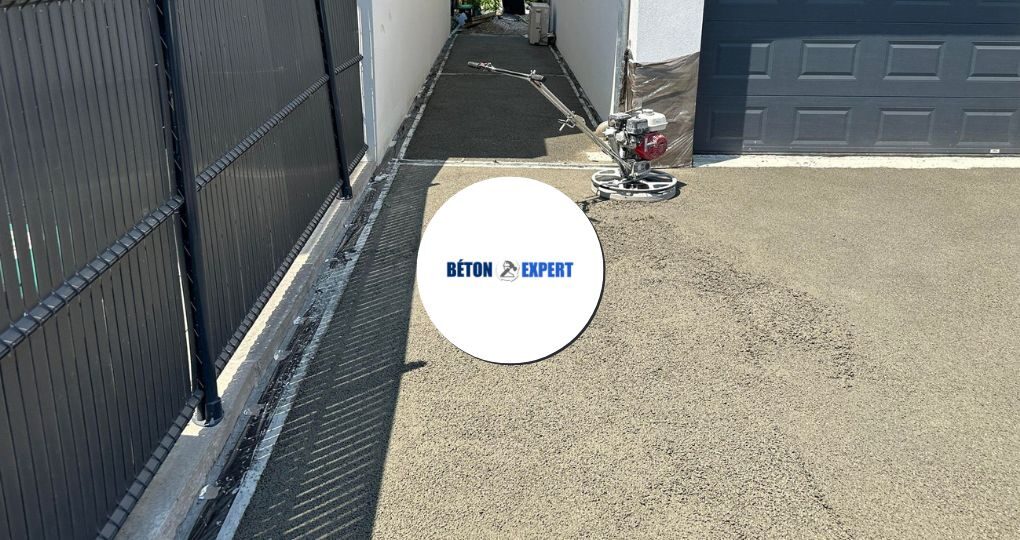
Permeable concrete requires precise and rapid application. It is not worked like conventional concrete. The time allotted for the work is limited, and the finish must be carefully controlled.
Improper execution can lead to:
- Premature cracks
- An irregular infiltration
- A non-uniform surface
Seeking the services of an experienced professional is strongly recommended.
What budget should be planned for permeable concrete?
The cost varies depending on the surface areaThe complexity of the construction site and the condition of the ground are factors. On average, the price for supply and installation is between 70 and 120 euros per square meter for a standard residential project.
This price generally includes:
- Preparing the ground
- The installation of the foundation layer
- The construction of the drainage slab
If the ground requires significant reinforcement, the cost may increase. A preliminary soil study is therefore useful to avoid unpleasant surprises.
A maintenance budget must also be included, even if it remains moderate compared to other development solutions.
In what cases is permeable concrete actually suitable?
Permeable concrete particularly suitable for projects where water management is a priority.
It is relevant if:
- You want to avoid water accumulating on a terrace
- Are you building a garden path or a residential access road?
- Are you looking for a permeable and modern coating?
However, it is not recommended if:
- The area is subject to constant heavy traffic
- The soil is very clayey and poorly absorbent.
- Regular maintenance cannot be guaranteed
Before making a decision, it is essential to analyze the soil type, the anticipated load level, and local climatic constraints. A thorough assessment will determine if permeable concrete is a sustainable and suitable solution for your project.
What is the lifespan of permeable concrete?
The lifespan of permeable concrete depends primarily on the quality of the installation, the thickness of the slab, and the maintenance performed over time. When properly installed, it can last between 15 and 25 years in a residential setting.
Several factors influence its longevity:
- The quality of the foundation
- Traffic intensity
- The weather conditions
- The regularity of the maintenance
In a driveway used by light vehicles, the lifespan can be very satisfactory. However, if the slab is undersized or poorly drained deep down, cracks or subsidence can appear more quickly.
It is important to understand that permeable concrete is not fragile, but it does require a design adapted to its intended use. A preliminary study and careful execution significantly extend its performance.
What maintenance is required to preserve its performance?
Permeable concrete requires simple but essential maintenance. Without regular cleaning, the pores can become clogged and reduce its infiltration capacity.
A suitable interview includes:
- Regular sweeping to remove leaves and dust
- Cleaning with moderately pressurized water
- Rapid removal of organic deposits
In wooded areas, it is advisable to intervene more frequently in order to avoid the accumulation of plant debris.
Unlike other coatings, it does not require any specific surface treatment. However, if permeability decreases, thorough cleaning may be necessary.
Simple but consistent maintenance helps to maintain the system's effectiveness over the long term.
What mistakes should be avoided when choosing permeable concrete?
Certain errors can compromise the success of a permeable concrete project. It is essential to identify them before starting work.
The most frequent mistakes are:
- Neglecting soil analysis
- Under-dimensioning the slab thickness
- Choose this solution for excessively heavy traffic.
- Hiring a company without specific experience
For example, installing permeable concrete on very clayey soil without a supplementary drainage system can lead to water saturation under the slab. This can cause movement and cracking.
It is also important to adapt the thickness according to the intended use. A pedestrian terrace does not require the same structure as a driveway.
A successful project relies on a precise analysis of needs, a suitable design and professional implementation.