Our article in brief
- The batten is not a decorative item, it is a piece of solid wood : the type of wood, the cross-section and the condition of its edges determine the final result even before installation.
- It works on a few specific surfaces: accent wall, headboard, screen, door or radiator cladding, riser, ceiling in small areas.
- The real issue is the pace : a tight gap makes a wall, a wide gap makes a screen, an irregular gap never forgives.
- Laid vertical, he stretches the room; ; horizontal, It widens it. On a frame, it compensates for an uneven wall; on a painting, it requires a sound support.
- Wooden battens alone on a bare wall are not an acoustic treatment The entire effect depends on what is placed behind it.
There are materials that transcend trends without ever wearing out, because they owe nothing to fashion: they owe everything to a gesture. The wooden batten is one of these. A piece of wood cut straight, planed, aligned with its neighbors—and a wall that suddenly begins to breathe, to capture the light differently in the morning and evening, to cast a moving shadow.
It is also, in my opinion, the most frequently misused material in contemporary decoration. Not just poorly placed: poorly used. drawn. Because the key to the result isn't determined during the screwing process, but much earlier—in the choice of wood, the cross-section, and especially the gap left between two blocks. That's precisely what we'll be looking at here: the material first, the technique second.
The wooden batten, a material before it was a trend
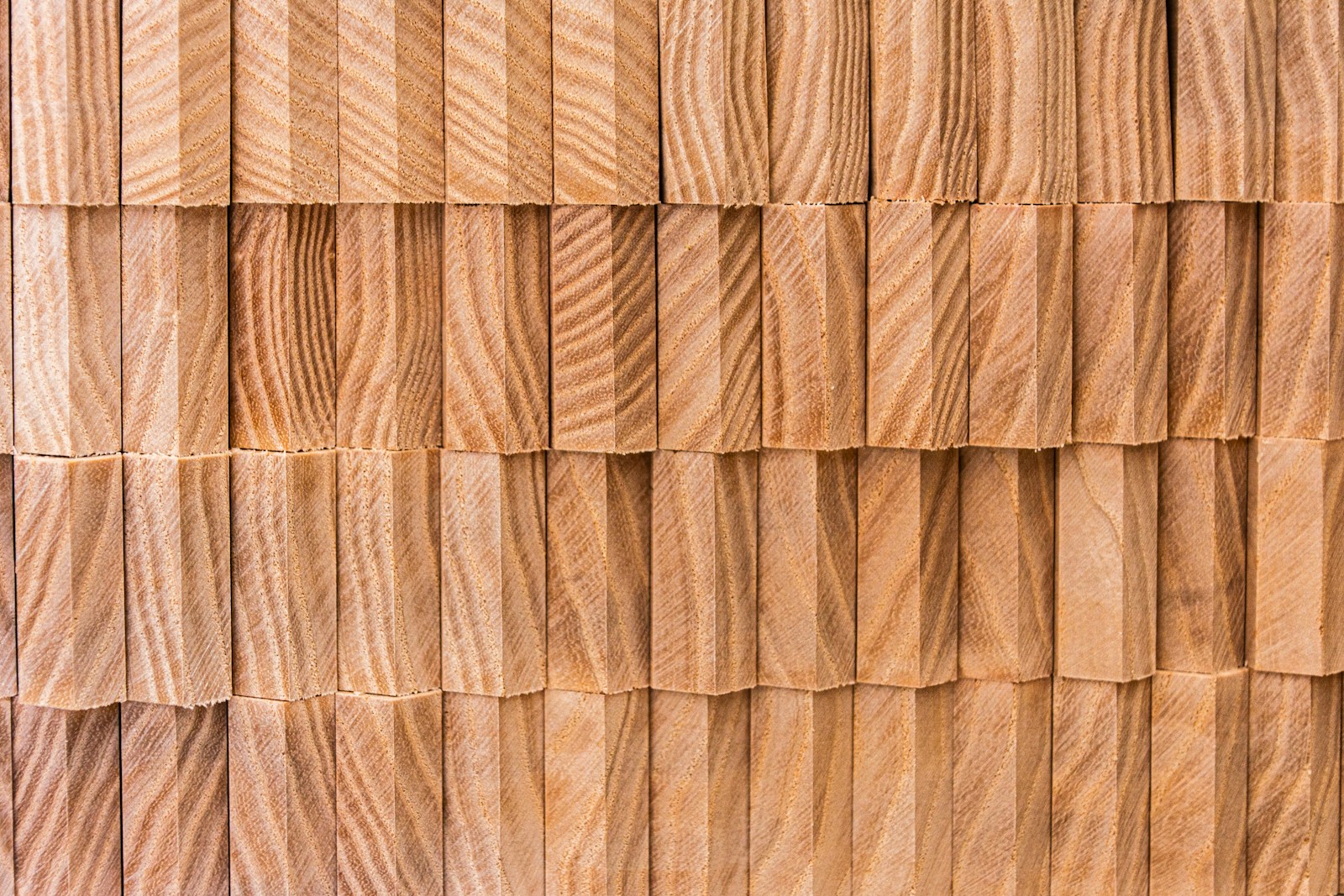
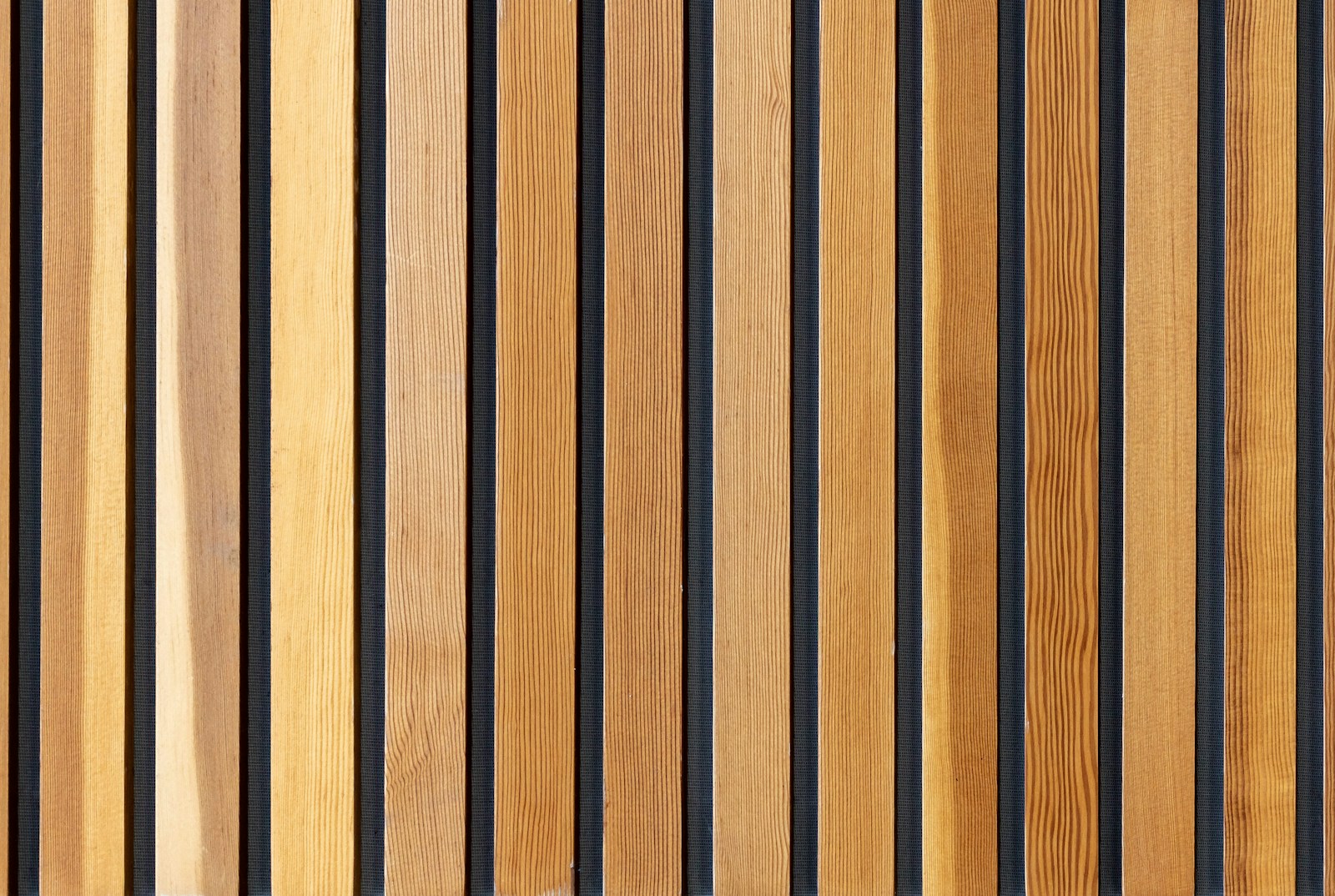
A batten is a piece of solid wood Small-section, square or rectangular, cut straight and then planed. In decoration, it is not transformed: it is used bare, aligned, repeated. Three parameters determine the final result before any installation — the wood species, the cross-section, and the edge treatment.
That's what I like about this material, and it's also what makes it demanding: there's nothing behind it. No printed design, no veneer, no effect. What you see on the wall is wood, with its grain, its variations in color from one piece to another, sometimes its knots. Like the terracotta, The batten belongs to that family of materials which do not need to be explained to be understood: they carry their origin within them.
Oak, ash, pine, walnut: which wood species for which effect?
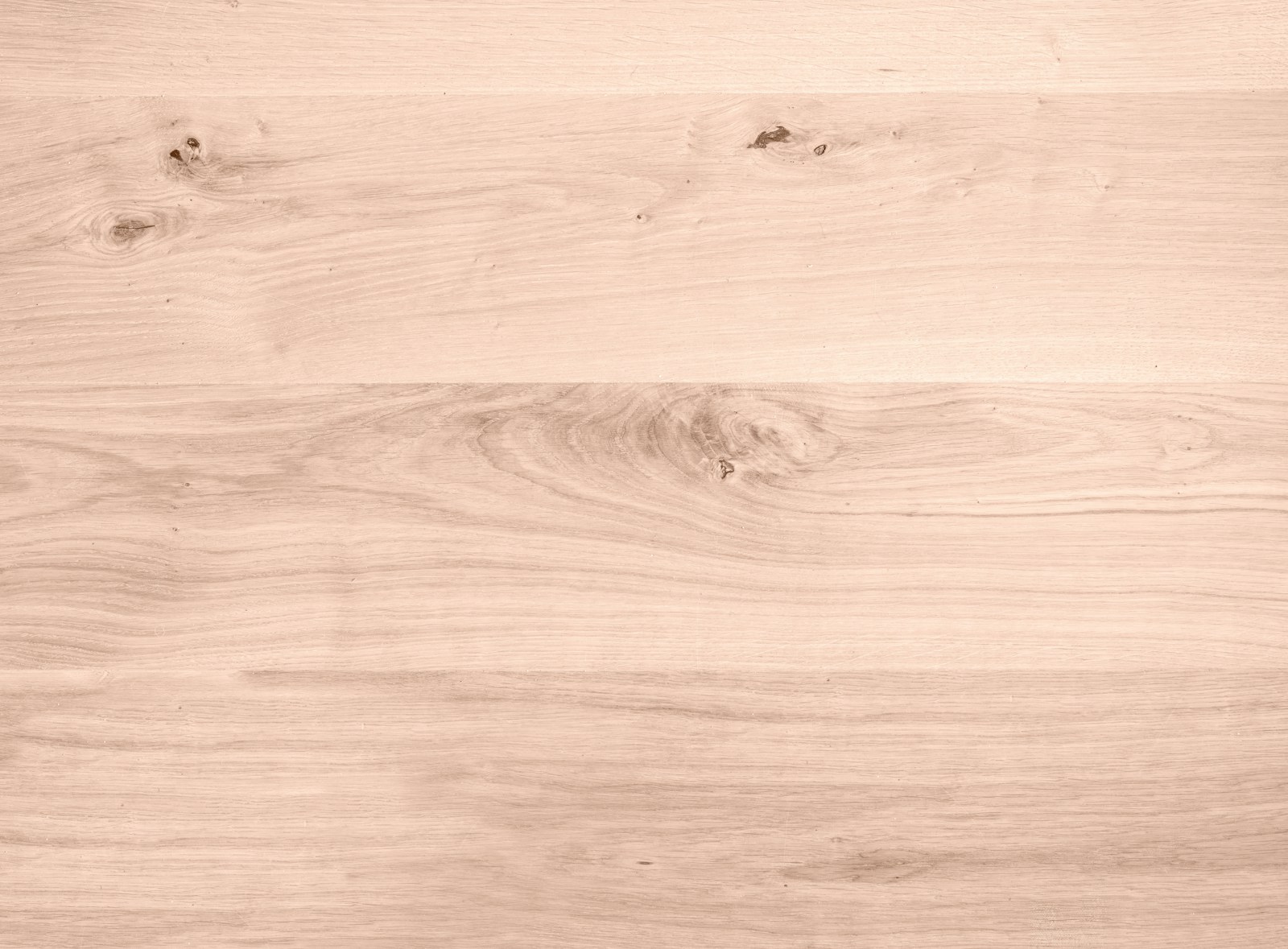
Indoors, in dry conditions, the question is almost never technical. wood use classes They classify uses according to their exposure to humidity, from sheltered interiors to submerged structures: a living room wall falls into the least demanding category, and practically all wood species can withstand it without special treatment. The choice therefore shifts to where it is most advantageous: aesthetics and relative price.
THE oak is the safe bet, golden blond that turns amber with age, with a clear grain that can still be seen from three meters away. ash is clearer and more dynamic: its design is almost graphic, very bright, it illuminates a dark room. pine It remains the most accessible, with its clearly visible knots and a distinct tendency to yellow — either embrace it wholeheartedly, or paint it. walnut, Finally, there is the most dressed-up one: deep brown, blended veining, superb on a small surface and quickly overwhelming on an entire wall.
| Essence | Color and veining | What it looks like on the wall | To be preferred when |
|---|---|---|---|
| Oak | Golden blonde to amber, with pronounced and regular veining. | Instant warmth, material legible even from a distance | You want a visible, risk-free framework. |
| Ash | Creamy white, with very defined and vibrant veining | More graphic, clearer, almost Nordic | The room is dark and you're looking for light. |
| Pine | Light-colored, yellowing, with visible knots | The most rustic and lively, the least regular | You either embrace the knots, or you paint tone-on-tone. |
| Walnut | Deep brown, soft and blended veining | The most dressed-up, very dark-colored supermarket | Small space: headboard, alcove, strip |
Section and edges: the two details that change everything

The most common formats revolve around a few small square and rectangular sections, and the choice is not neutral. square section It creates a clean, almost abstract grid, where each batten counts as much as its neighbor. A rectangular section placed on singing — that is, narrow face towards you, depth towards the wall — creates a pronounced relief and a long shadow: this is the most spectacular option. The same section laid flat disappears and produces a simple scratch.
Next comes the detail that almost no one looks at in stores, and which changes absolutely everything: the’fish bone. A sharp edge creates a clean line, a stark shadow, a contemporary look—but it shows every bump and is unforgiving of overly generous paint application. A rounded or chamfered edge softens the light on the edge of the batten, giving a more handcrafted, gentler feel, and ages much better in a hallway or on a staircase. Look closely at this edge before buying: from a distance, it sets the tone.
The surface condition remains. The wood rough planing It requires careful sanding before finishing, but you retain control over the final color. pre-painted It saves real time and guarantees consistent color from one batten to the next; in exchange, you forgo the grain, and therefore half of what makes this material beautiful. My choice is simple: pre-painted if the batten is to blend into the wall, unpainted if the batten is the focal point.
Untreated wood ages: should we be worried?
Yes, it ages, and no, that's not a problem—provided you decide to let it rather than just discover it. Bare wood changes under the influence of light: pine yellows distinctly, oak turns amber, walnut loses some of its depth. It's slow, steady, and honestly, quite beautiful.
The real risk isn't the patina, it's the patina itself. unequal. A large piece of furniture placed in front of part of the wall, a ray of sunlight that only hits half the surface, and you'll have a visible border after a few seasons. Two precautions are all it takes: apply a finish that slows down and evens out the process, and use battens from the same batch, cut from similar woods, to avoid color variations from day one. It's the same care you'd give to a beautiful solid wood table Matter is alive, we accompany it.
Where the wooden block actually works
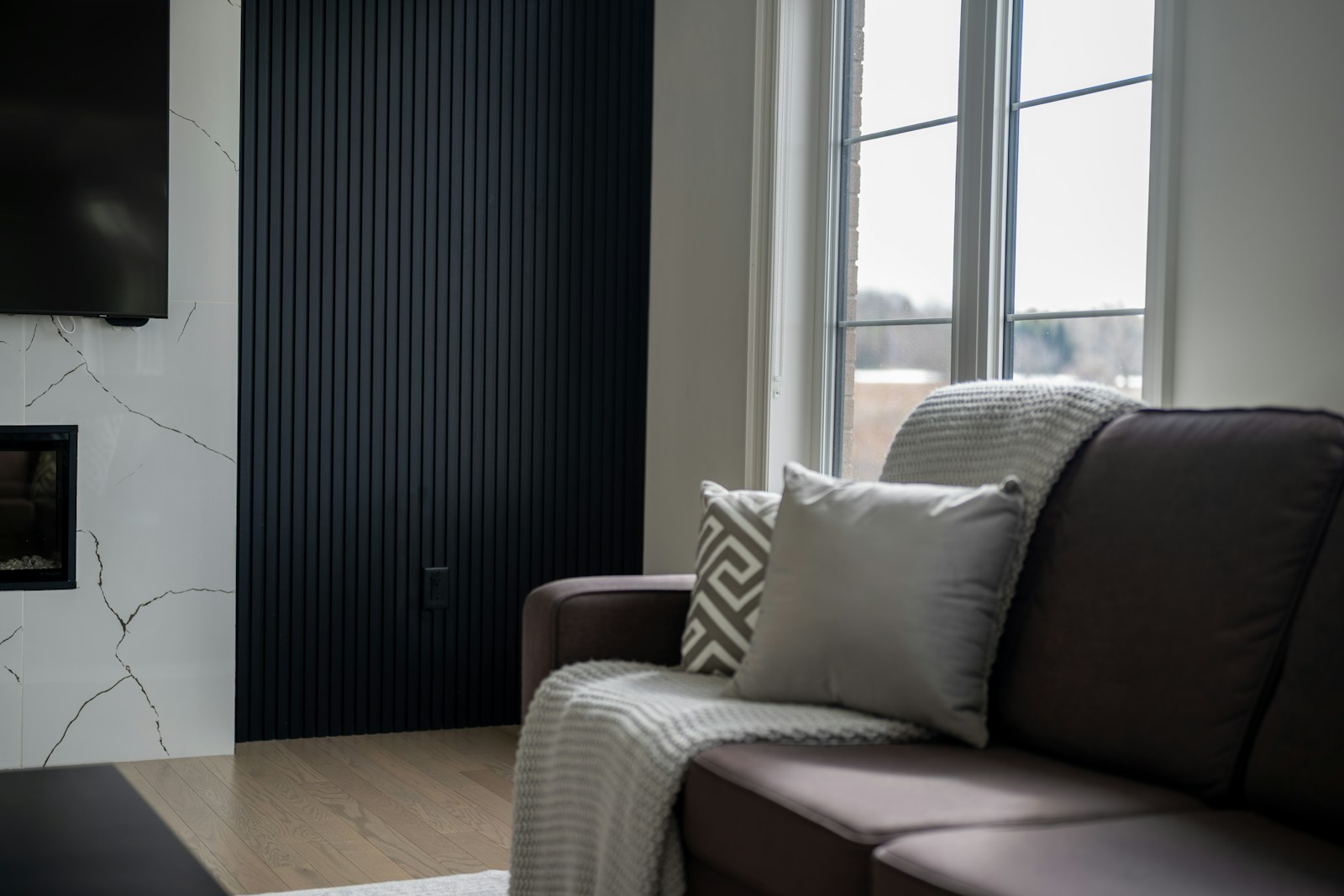
The batten doesn't need to cover an entire interior to exist. It works when it treats a precise surface and gives it a role: a wall that one wants people to look at, a separation that one doesn't want to close, an element that one would like to make disappear. Everywhere else, it becomes a tic.
THE accent wall The first obvious point is that there's one selection criterion I find more useful than all the others: choose the wall that receives the light. at an angle, by skimming. A wall lit from the front remains flat, regardless of the relief placed on it; a wall touched by the light from a side window or a wall light makes the shadow work between the battens, and it is this shadow that draws, not the wood.
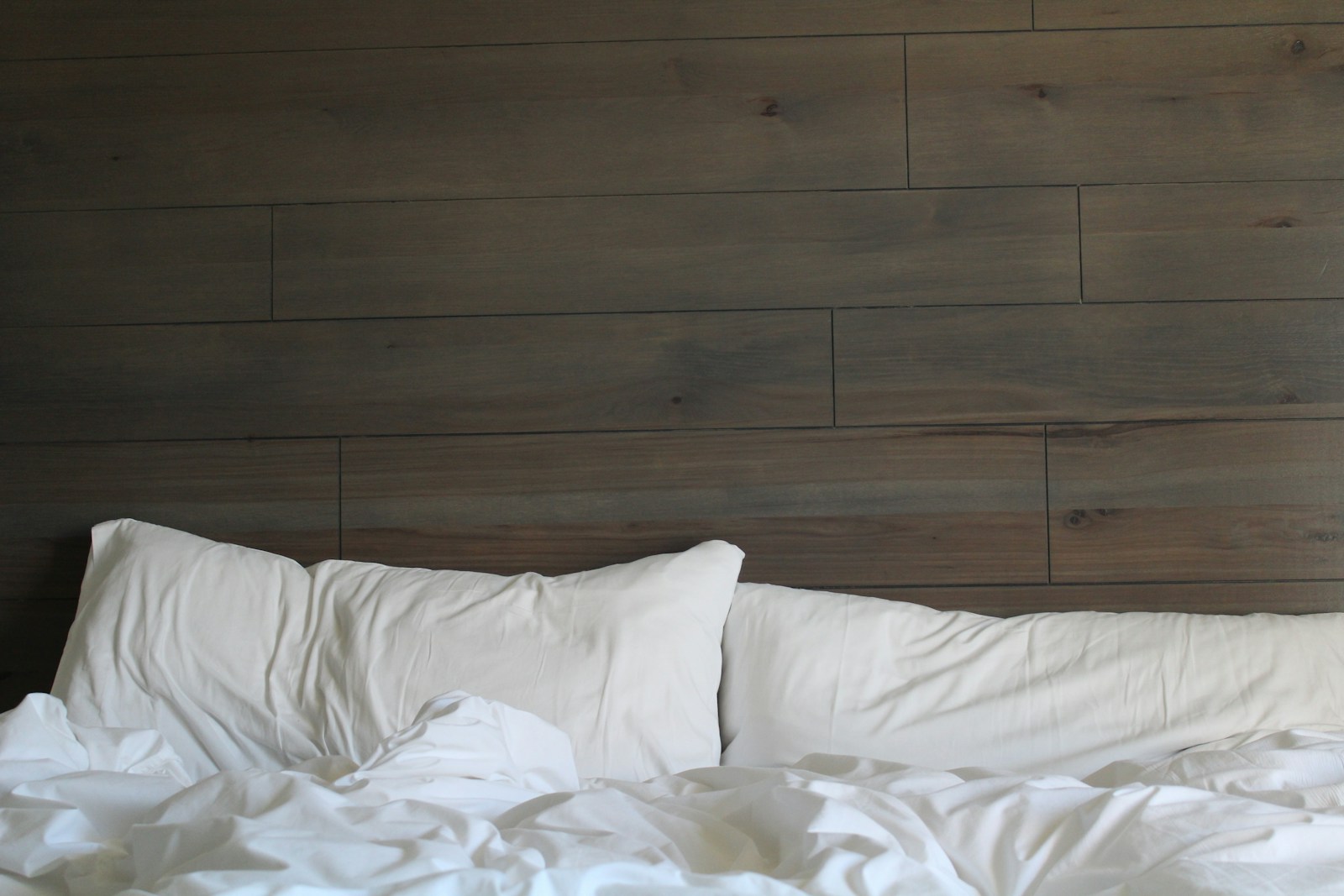
There headboard is the second sure thing, and probably the easiest to achieve when starting out: the surface area is limited, mistakes are easily overlooked, and the effect is immediate. A tip regarding proportions that I always apply: extend the fabric beyond the bed on both sides, by a good width of a bedside table. A panel exactly the width of the mattress visually narrows the bed; extending beyond it makes it appear larger. It's one of the most effective ways to... redesigning an adult bedroom without changing any of the furniture.
- The accent wall — the one that receives light at an angle, never head-on.
- The headboard — small surface area, maximum effect, ideal for a first try.
- The screen — separating an entrance, an office, a stairwell without partitioning.
- Door cladding — extending the pattern onto the door leaf to make the door disappear.
- The radiator cover — provided that air is allowed to circulate freely.
- Stair risers — a narrow surface, very visible, very exposed to impacts.
- The ceiling — only in small areas: a band, a coffer, the top of a corridor.
The screen: separating without partitioning
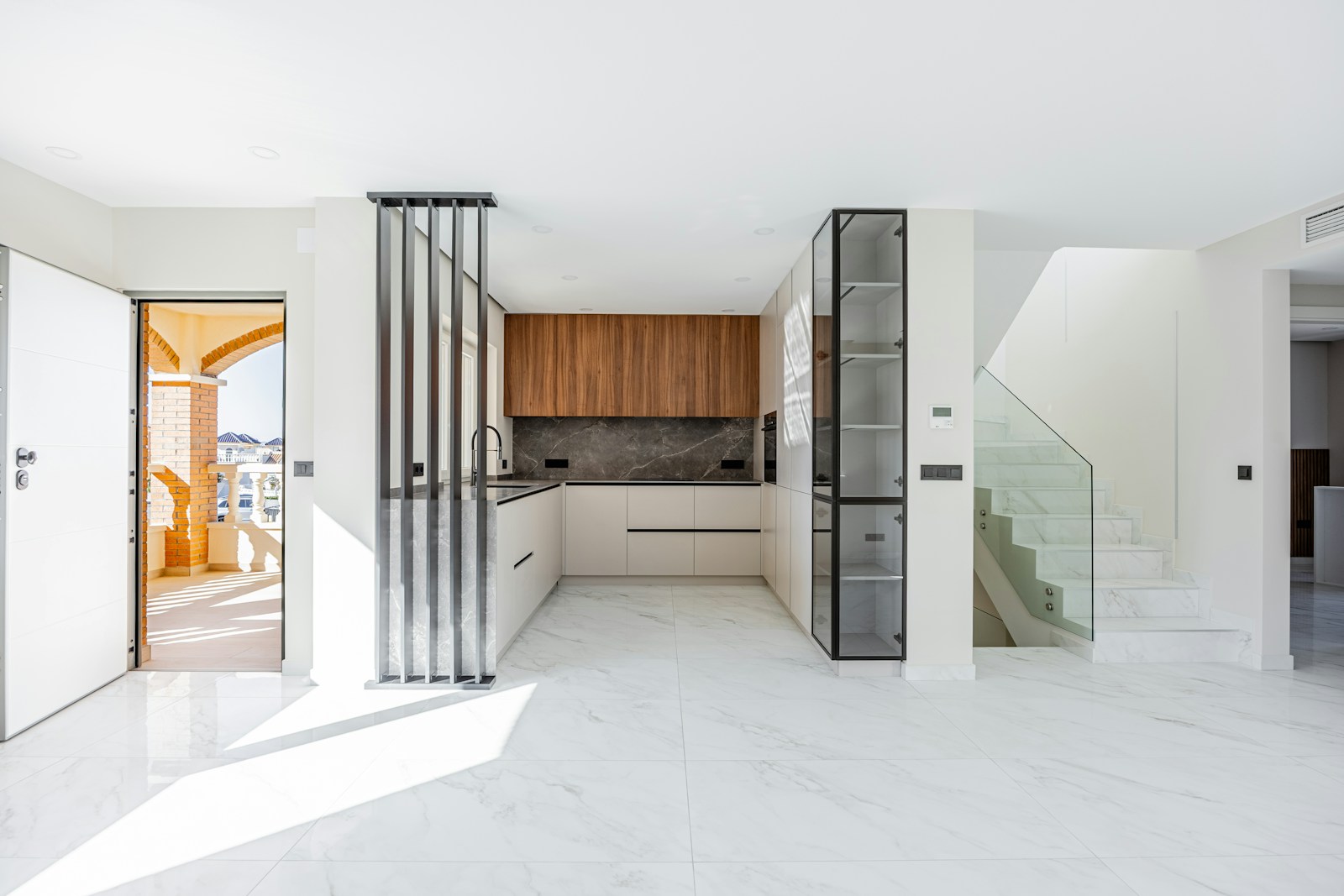
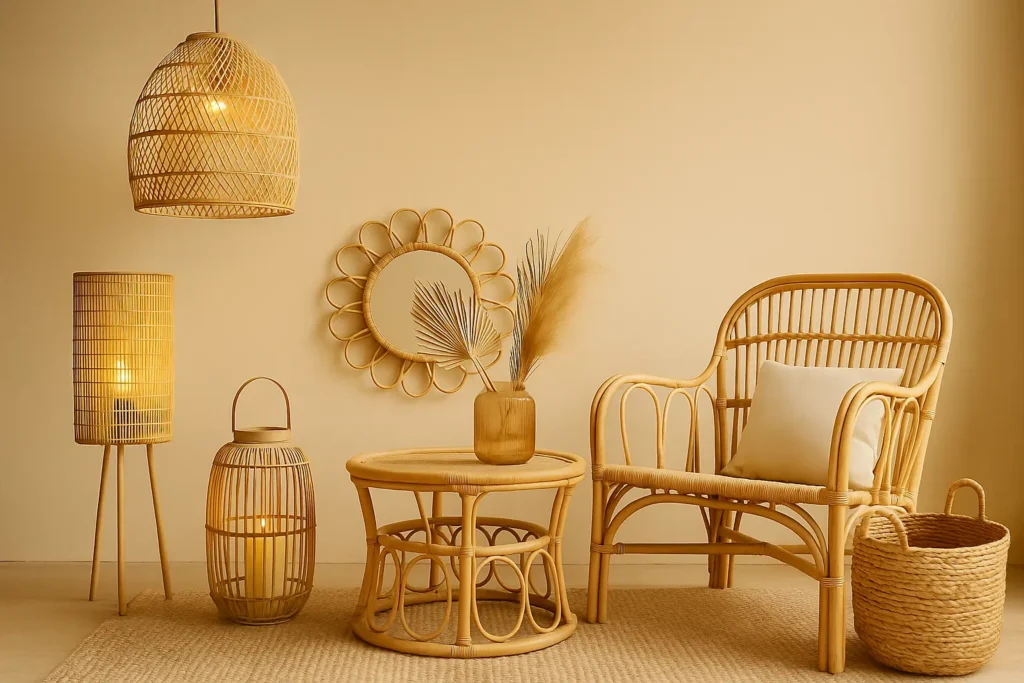
A screen is the most ingenious use of a wooden batten, and the most poorly calibrated. Its purpose is to delineate without obscuring: an entrance that opens directly into the living room, a home office nook set up in a living space, a staircase that one would like to be less open. The principle is exactly that of... rattan and bamboo light fixtures : we don't block the light, we cut it.
Hence a non-negotiable rule: a screen requires a wide gap. Tighten the battens and you haven't made a screen, you've built an openwork partition that takes up space without adding anything. The void should dominate the solid—it's what allows the eye, light, and air to pass through. As for mounting, there are three solutions depending on your ambition: floor-to-ceiling mounting, holding it in a separate frame, or placing it on an existing half-wall, which is by far the simplest option to achieve.
Door, radiator, stair riser: dressing up what's inconvenient
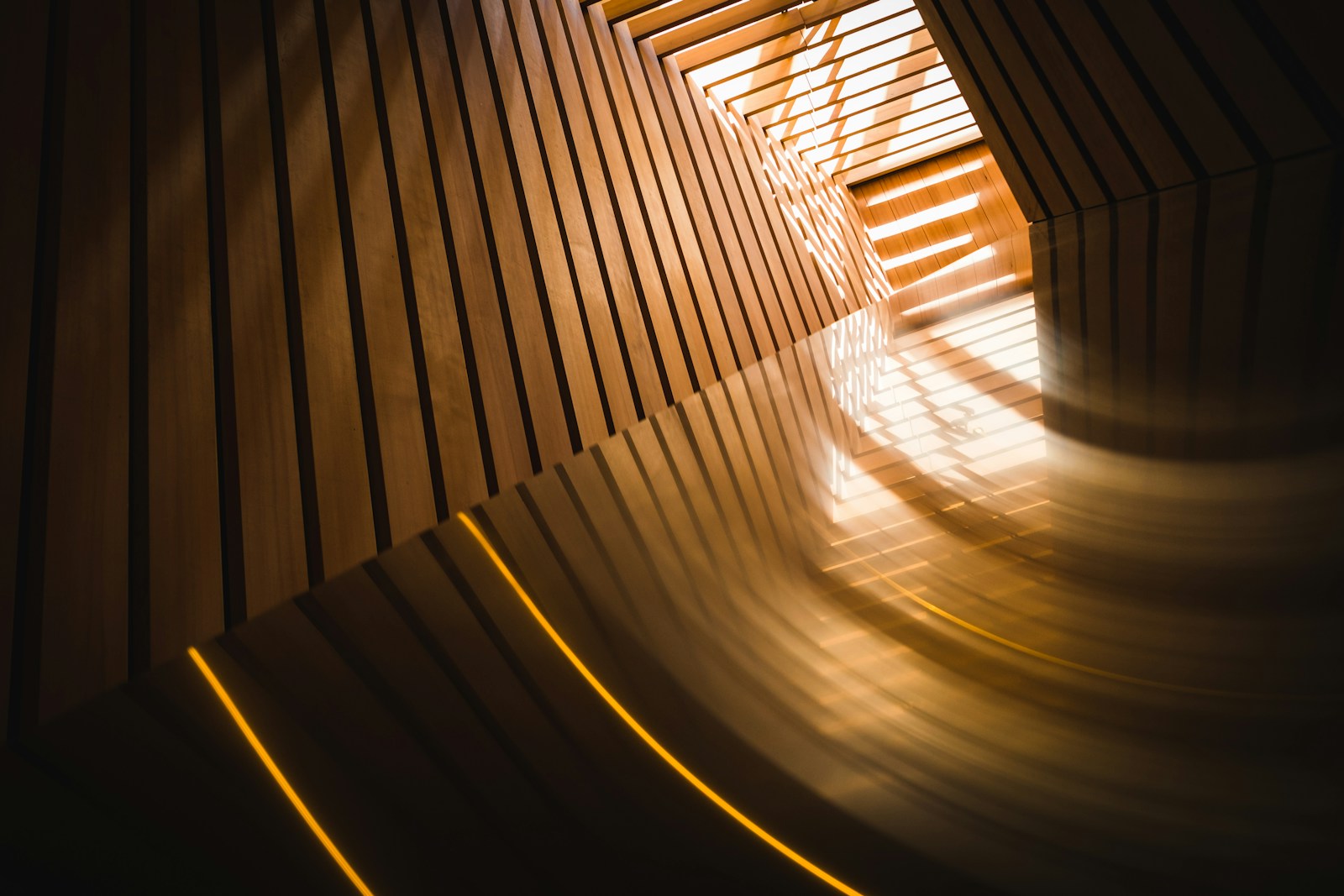
This is my favorite type of work, by far, because it doesn't try to decorate: it remedies a flaw. A door that continues to be treated like a wall, by extending the grain onto the door leaf, literally disappears from view. An ugly radiator behind a curtain of slats becomes a piece of joinery. Dressed risers transform a utilitarian staircase into a work of art—with, here, a clear preference for rounded edges, because this surface is kicked all day long.
The ceiling deserves the same measured treatment: a band, a coffered ceiling, the top of a hallway, but rarely the entire surface—in fact, we dedicate a whole article to ceiling decoration, where paneling and beams play their own part. And if it's the large living room wall that occupies your attention in its entirety, with all its possible options, it's the subject of a separate guide: here, the focus is on the batten, not just one solution among twelve.
⚠️ Two situations that cannot be resolved alone — Any cladding installed in contact with a heat source (radiator, stove) or near a flue is subject to distance and ventilation regulations that vary depending on the appliance: have the installation validated by a qualified installer. The same applies to a screen that is part of the structure, replaces a railing, or bears a load: it is a carpentry or framing element, not a decorative one. A professional must determine its load-bearing capacity.
The rhythm: the gap between the cleats decides everything
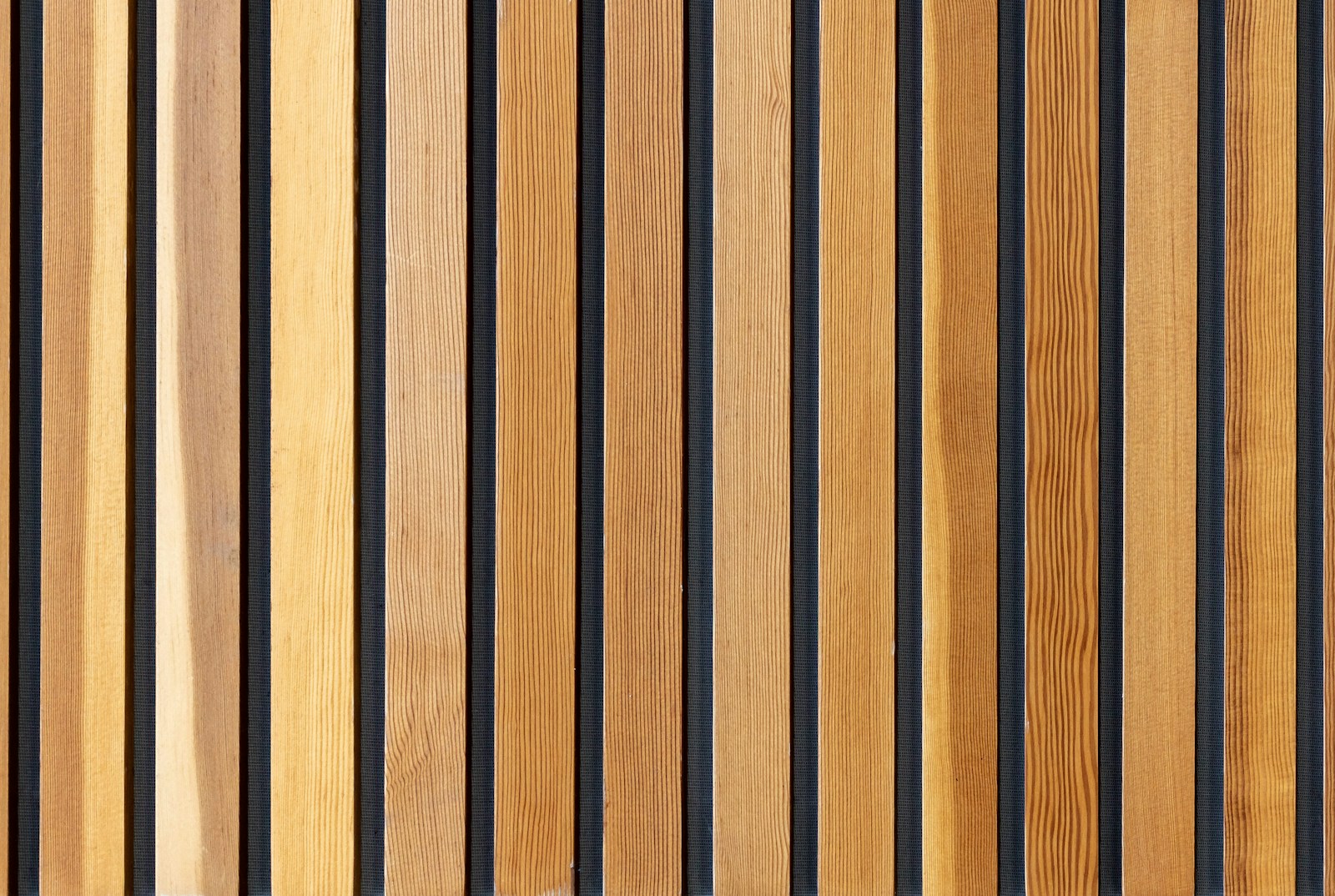
This is the topic that almost no one addresses, yet it explains the majority of both successes and failures. The gap between two battens is the true key to this decoration. Think about it. relative to the width of the batten, never in absolute centimeters: a gap narrower than the batten gives a solid wall, an equal gap gives a grid, a doubled gap gives a screen.
This method of calculation has a decisive advantage: it works with any section. Change the format, keep the ratio, and you retain the effect. It also allows you to decide on the final look on paper before buying the first piece of wood.
Tight, grid-like or latticework: three differences, three results
- Narrower gap than the cleat (about half its width) — the wood dominates, the background disappears. We no longer see a motif but a surface It's a wall that's dressed up, warm, and enveloping. The most material-intensive and imposing element in a small room.
- Gap equal to the width of the cleat — wood and background in perfect equality. That's the plot, This is the most readable, graphic, and easiest rendering to achieve. If you're hesitating, choose this one.
- Difference of two or more widths — emptiness dominates, the gaze passes through it. It is the screen. Warning: the background becomes fully visible, so it must be treated as a true decorative surface.
Why is an irregular gap always visible?
Because the eye doesn't measure: it compares. Faced with a regular pattern, it reads an intention and ceases to analyze. As soon as an interval differs from its neighbors, it latches onto it and reads a flaw—not a variation, a flaw. And it doesn't let go.
There is only one exception, and it is a demanding one: an irregularity Frankly The arrangement is deliberate and systematic, in groups of three or five battens separated by a wider gap. Here, the eye finds a logic, and therefore a rhythm. The worst result is always the in-between: the almost-regular, where one senses a disrupted pattern without understanding why. The most classic pitfall is the last row—one aligns them neatly from one edge, and the final interval absorbs all the accumulated errors. It is precisely the only part of the wall one looks at upon entering.
The gap between two battens isn't a detail of the installation: it's the design. Tight, you have a wall. Wide, you have a screen. Inconspicuous, you have nothing.
Start from the wall, not the batten.
The method that avoids unpleasant surprises lies in a reversal: instead of starting with a chosen gap and then setting limits until it falls, we start from the exact width of the surface And then we distribute the battens. Measure the wall, first decide whether you want a batten or a gap at each end—this choice creates symmetry—then distribute them. And accept adjusting the gap by a few millimeters across the entire pattern: no one will ever see this correction, whereas everyone will see a split batten at the end of the wall.
Last point, often forgotten until it's too late: the bottom. It is painted beforehand, never after. A dark, matte tone accentuates the space between the battens and creates remarkable depth; a tone-on-tone softens the effect and makes the texture appear as relief rather than a pattern. Conversely, a glossy white reflects light into the gaps and flattens all the relief you have just created.
💡 Tip Before fixing anything, place four or five battens against the wall at the distance you intend, then step back three meters and look at them in the evening light. The rhythm is judged from a distance and in raking light, never with your nose right up against the wall. Ten minutes of testing is better than having to take down an entire wall.
Attaching the battens: on the canvas, on the frame, and in which direction?
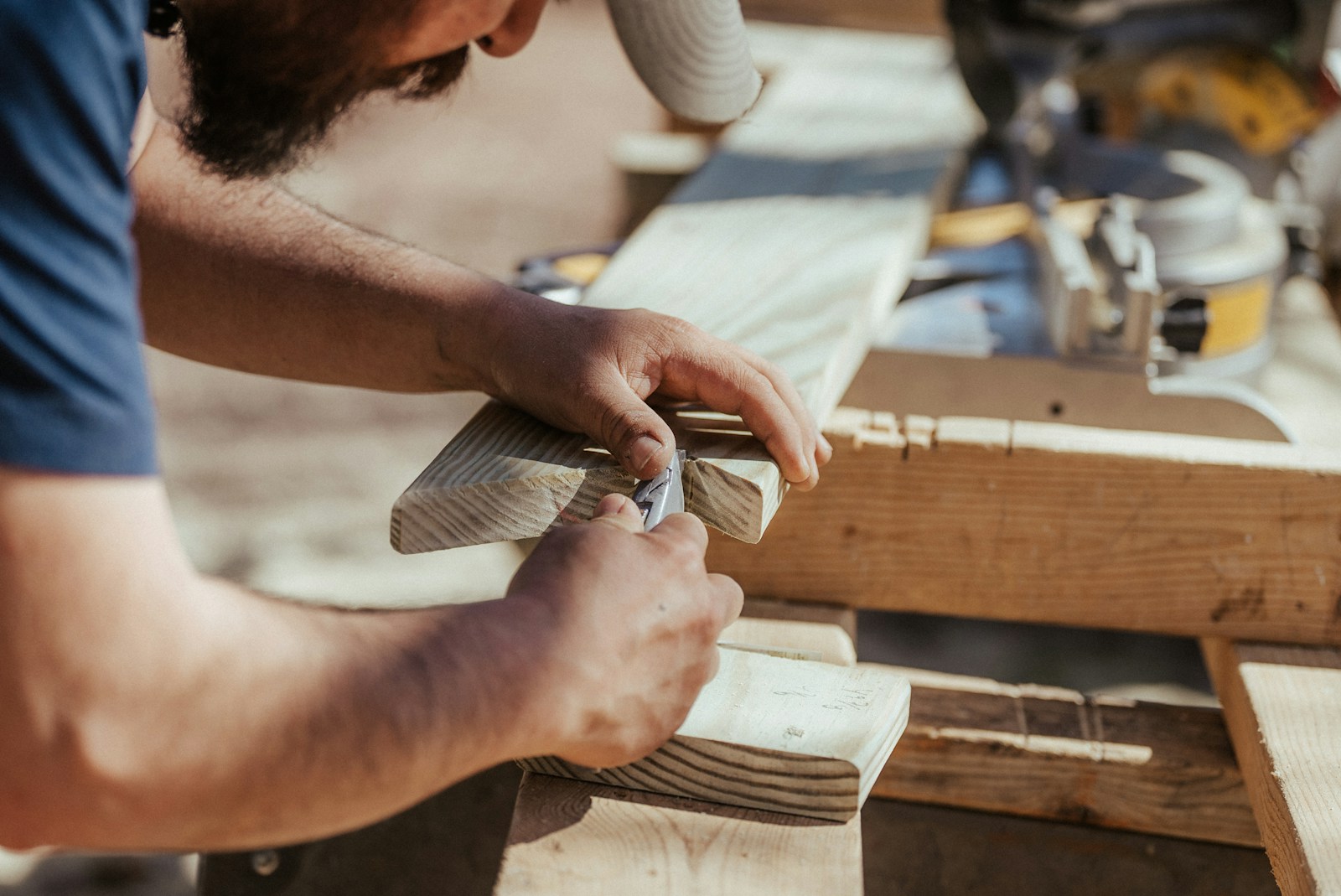
Two methods exist, and they do not give the same result. On the board, The battens are fixed directly against the wall: it's quick and space-saving, but the surface must be flat, sound and dry. On frame, First, a framework of battens is fixed and the cleats are placed on top: more work, but a perfectly straight finish even on a wall that is not straight.
Video: a wall made of wooden battens installed in real-world conditions (Mathilde & Jérémy channel).
On a canvas or on a frame: which to choose?
Mounting on a picture frame is only justified when the wall is already in good condition: flat, clean, and free of any dampness. A dab of suitable adhesive and a few screws are all you need, and you lose almost no thickness. Its limitation is structural, in the truest sense: there's no void behind it. Therefore, no cables to run, no LED strips, no sound-absorbing materials—and absolutely no tolerance for uneven walls.
The frame installation method is more generous. The frame is positioned perpendicular to the battens—horizontally if your battens are vertical, and vice versa—it's leveled by shims, and it compensates for any imperfections in the wall. Above all, it creates a a few centimeters, And this void is what makes everything else possible: cable routing, indirect lighting, sound-absorbing material. Remember this; we'll come back to it for acoustics—it's the same idea. If this void is to house electricity, hire an electrician for the power supply.
Vertical or horizontal: what each direction does to the room
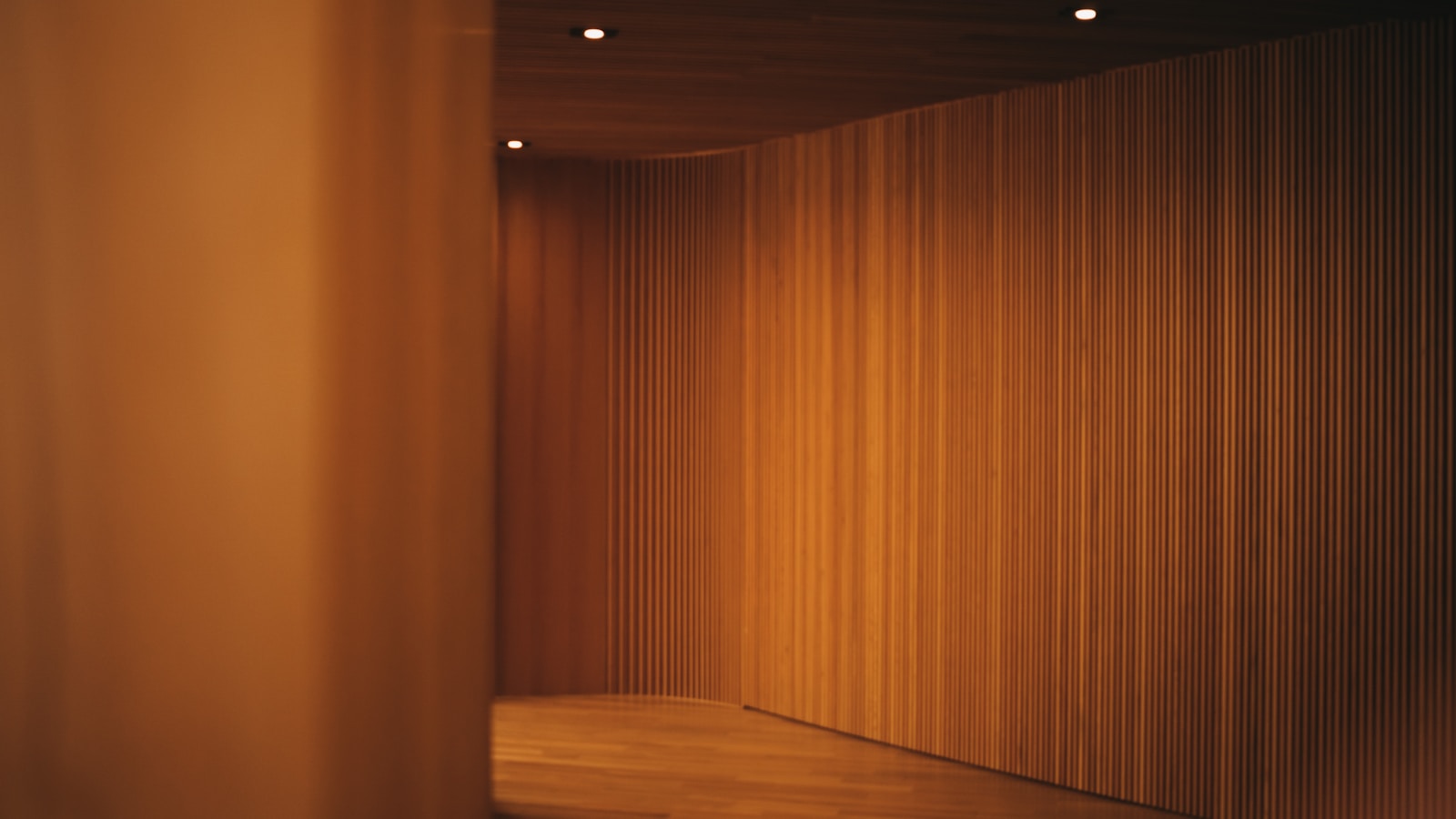
The direction of the pose is not a matter of taste, it is a tool for correction. Vertical, The batten creates a sense of height: it draws the eye upwards and gives the impression of greater height. This is the most common and useful orientation in an entryway, a narrow hallway, or a room with a low ceiling. Horizontal, It widens and soothes: it lengthens a short wall, calms a restless room, but it emphasizes a low ceiling instead of redeeming it — and its upper edges become so many small dust shelves.
Diagonal and chevron patterns are possible, even spectacular, but I advise against them for a first project: each cut requires maintaining an angle, and keeping the rhythm consistent is twice as difficult. Then there's the question of the stopping height. Full height for an accent wall is a bold statement. For a headboard, I often stop around two-thirds of the wall's height: the pattern frames the bed without overwhelming the room. And a simple low band, at the base of the wall, is sometimes enough to structure a hallway.
Oil, wax, matte varnish or tone-on-tone paint
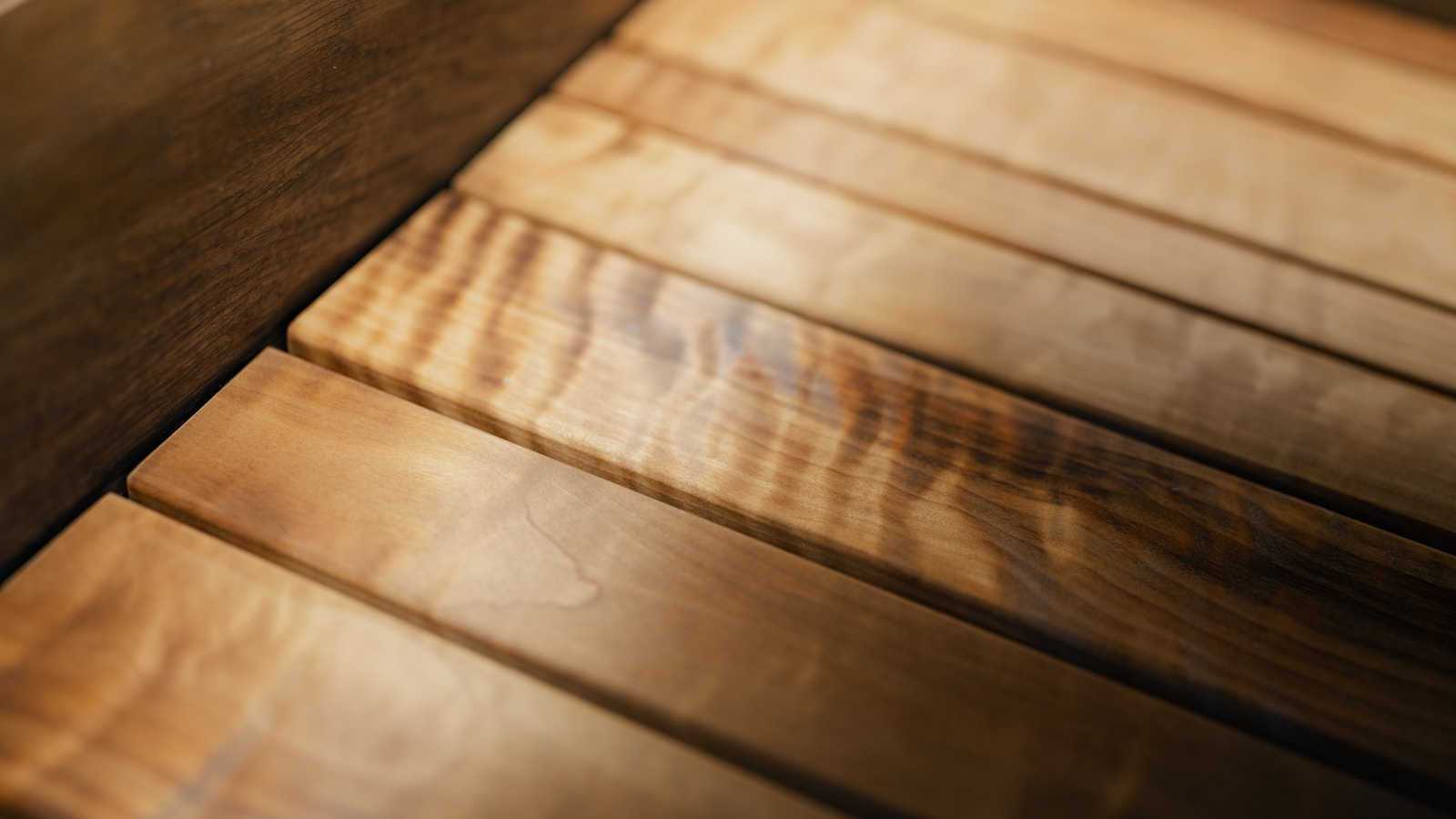
- The oil It nourishes the wood, reveals the grain, and slightly darkens it. It can be touched up in sections, without having to redo everything. It's my favorite finish on oak and ash because it allows the wood to breathe.
- The wax — It has a very soft, subtle satin finish, almost velvety feel. However, it is sensitive to water and needs to be replaced more often.
- Matte nail polish — the most protective and easiest to clean, therefore the right choice for a staircase or riser. However, it hardens the material and is difficult to touch up locally.
- Tone-on-tone painting — battens and background in the same shade: only the relief and the shadow remain. Radical, very graphic, and often the most appropriate decision when the essence has nothing to say.
A word about wet areas, since the question keeps coming up: wood isn't forbidden there, it's simply more demanding. Outside of areas of direct splashing, with a suitable finish and proper ventilation, a framework of battens works very well in a bathroom. In the shower or directly above a bathtub, however, it's a different story.
Acoustics: what battens do, and what they don't do
Let's be clear, because this is the most widespread and most misleading promise: wooden battens screwed onto a bare wall they do virtually no improvement in acoustics of a single piece. The wood is dense, it reflects sound. What absorbs the sound is what is placed behind it — a porous material and an air gap. Without this, the effect is visual, not auditory.
I prefer to say it this way rather than perpetuate the misunderstanding, because many people are undertaking this project. First of all for a room that resonates, and end up with a nice wall and exactly the same echo. It's not that acoustics are beyond our reach: it's that they play out elsewhere than in the batten.
What's behind it does all the work
The mechanism is simple to understand. For a sound wave to lose its energy, it must between in a porous material—thick felt, fiberboard, wool—and is exhausted by friction. The battens, on the other hand, merely create gaps through which the wave can reach this material. They are the passage, not the absorber.
Three conditions must therefore be met simultaneously: an absorbent material placed against the wall, an air gap between it and the battens, and a sufficient amount of air between the battens to allow sound to pass through. This is precisely the principle behind commercially available batten-on-felt panels—their advantage lies not in the visible wood, but in the invisible textile. Conversely, a tightly woven mesh placed on a canvas against bare plaster will produce no measurable effect. It's best to know this before buying.
Diffuse, absorb, isolate: three different promises
Absorb, It's about reducing reverberation inside the room — the echo, that impression of an empty room that resonates. That's almost always what we're looking for, and it requires a significant amount of porous material. Broadcast, The idea is to break up the reflections and distribute them throughout the space instead of reflecting them all at once: a regular pattern of battens does indeed create some diffusion, especially in the high frequencies. The effect is real, but modest, and not the one we were hoping for.
Isolate, Finally, it's about preventing sound from passing from one room to another, and that's completely unrelated: it's a matter of mass and decoupling. Wooden battens don't insulate, and a screen even less so—it's perforated by design, sound passes through it like light. If acoustic comfort is your primary objective rather than a bonus, the technical documentation of the CNDB address these topics, and an acoustician will save you considerable time: he will tell you where to place the absorbent material, something the batten will never be able to tell you on its own.
What remains, then, is what has made this material beautiful from the beginning, and which has never needed any technical explanation: a piece of wood, a regular gap, a shadow that shifts with the day. The wooden batten doesn't try to imitate anything other than itself. That's already quite something—and that's precisely why it endures, season after season, when patterns change.
Want to make raw wood the central theme of your interior?
Our guide to furnishing your homeYour questions about decorating with wooden slats
What space should be left between two wooden battens?
Think in terms of the width of the batten rather than centimeters. A gap of half the width creates a solid wall, a gap equal to the width creates a graphic pattern, and a gap of two or more widths creates a screen. The key is regularity: an irregular interval is always noticeable.
What is the difference between a batten and a lath?
The dimensions are similar, but their uses differ. A batten is planed, calibrated, and meant to be seen: it's a finishing piece. A lath remains rough-sawn, less regular, and serves as support—particularly in roofing, under the tiles. In wall decoration, the lath provides the framework, while the batten provides the decoration.
What type of batten should I choose for wall decoration?
In dry indoor environments, the choice is primarily aesthetic rather than technical. Oak provides immediate warmth, ash brightens a dark room, pine is suitable if you're comfortable with the knots or want to paint it, and walnut is ideal for small spaces. Pay particular attention to the edges: sharp for a contemporary look, rounded for a more handcrafted feel.
Does a wall made of wooden battens improve acoustics?
Not on its own. Wood is dense and reflects sound: battens placed on a bare wall do virtually nothing to reduce reverberation. Absorption comes from what's placed behind it—felt or a porous panel, plus an air gap. Without this, the effect remains purely visual.
How to integrate LED lighting behind wooden battens?
It needs to be mounted on a frame: the space between the frame and the battens is where the strip lights are installed. Position it out of direct view so that only the glow is visible, choose a warm light source, and plan for its power supply beforehand. Have the electrical connection done by a professional.
Can you install wooden battens in a bathroom?
Yes, except in areas where direct splashing will occur. A finish suitable for humid environments and proper ventilation are essential, as wood use classes differentiate between dry and humid interiors. In the shower or above a bathtub, choose a different material.