You've spent months hunting for the perfect teak sideboard, finding the ideal linen cushions, and hanging that carved wooden mirror that sets the tone for your entryway. And yet, something is missing. The floor feels hollow—not literally, but visually. This is often where a well-chosen rug makes all the difference.
In a colonial-inspired interior, the rug is not just an accessory. It's the piece that anchors everything else, that connects the materials together, and that brings that feeling of warmth we all seek when we walk through the door of our home.
In this article
Materials that work (and those that don't
Colonial style is above all a dialogue between wood, raw fibers, and natural textiles. The rug must be part of this conversation without disrupting it.
Jute remains a safe bet. Its rough texture, raw look, and blond hue blend perfectly with dark wood floors or terracotta tiles. It's the kind of rug that looks like it's always been there—and that's exactly the desired effect. Woven wool also works very well, especially in ecru, cream, or sand tones. Barefoot in the morning, the difference from a synthetic rug is immediately noticeable: it's dense, it's warm, and it absorbs everyday noise.
On the other hand, overly smooth or shiny materials disrupt the ambiance. An ultra-smooth viscose rug placed under a solid, aged wood table? It clashes. Colonial style calls for texture, grain, something you want to touch.
Brands like Matta These companies specialize in handcrafted patterned rugs—kilims, Berber, geometric—that blend seamlessly into an ethnic interior without looking like a haphazardly placed holiday souvenir. The best approach is to look for rugs whose weave tells a story, rather than a flat, solid color.
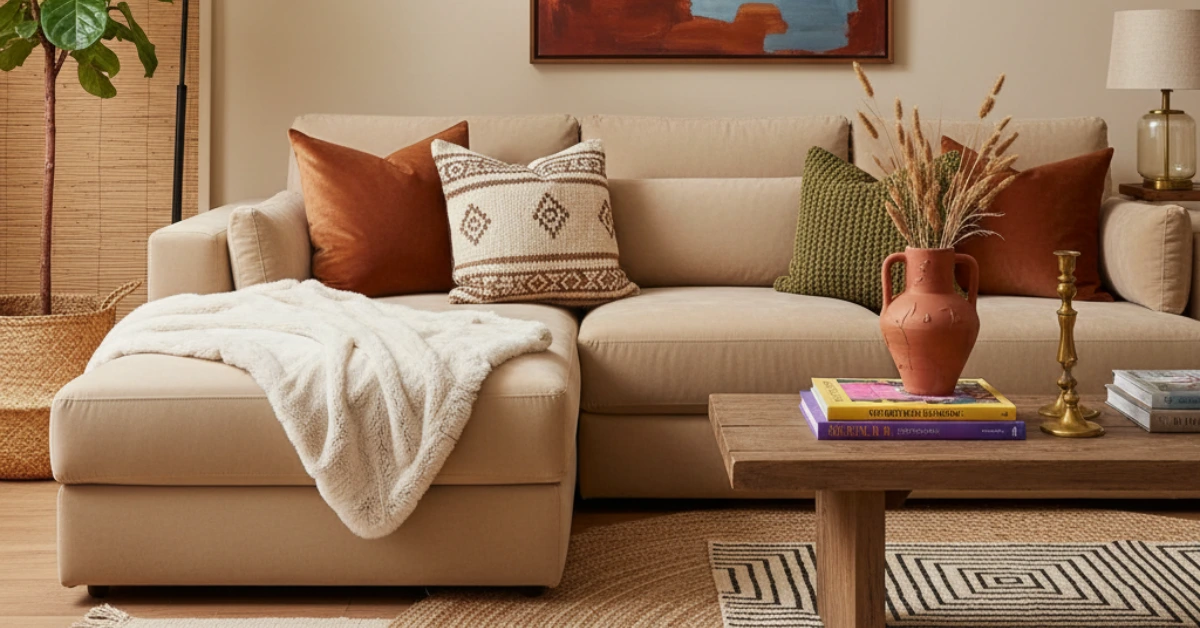
Size: the mistake everyone makes
A friend furnished his entire living room—a distressed leather sofa, a mango wood coffee table, a rattan floor lamp—before even thinking about the rug. He chose a 120x170 cm one. In a 28 m² living room. The result: the rug looked like a postage stamp in the middle of the room.
The rule is simple, even if it's often forgotten: the rug should be larger than you think it will be. In a living room, the front legs of the sofa and armchairs should rest on it. Under a dining table, allow at least 60 cm of overhang on each side so that the chairs stay on the rug even when they're pushed back.
And in an entryway or hallway—those often-neglected passageways—a runner rug in braided jute or flat-woven cotton is enough to warm up the atmosphere. No need for a huge budget: it's the thought that counts, not the price per square meter.
Patterns or plain: it all depends on what already exists
Here, we enter the realm of personal taste, but a few guidelines can help you decide. If your colonial interior is already quite busy—wood paneling, travel souvenirs, textiles on the walls—a plain or very discreet rug will provide visual relief. Beige, warm gray, and soft terracotta work well as neutral bases.
Conversely, if your room is rather minimalist with beautiful raw materials but little whimsy, now is the time to dare to introduce a pattern. Geometric designs with Berber influences harmonize remarkably well with colonial furniture. However—and this is where many go wrong—the pattern must remain within a muted color palette. Bright, saturated colors, very tempting on a screen, often take up too much space once laid on the floor in an interior with natural hues.
In short, the question isn't "pattern or no pattern." It's more like: what story does your floor need to tell for the whole thing to hold together?
One last thing
A rug is perhaps the only decorative item we truly test with our feet before our eyes. So before finalizing a choice based on a photo, ask yourself a simple question: would I want to sit on it on a Sunday morning with a coffee? If the answer is yes, you've found the right one.