Renovating an old house is a rather unique project. It often begins with the desire to improve comfort, increase insulation, or modernize certain rooms. Then, as the work progresses, another question arises: how can we transform the house without erasing precisely what attracted us to it in the first place?
A slightly uneven wall, beams bearing the marks of time, a patinated terracotta floor or a few exposed stones often contribute much more to the character of a place than a perfectly controlled decoration.
That's why the choice of materials seems essential to me in an old renovation. It's not necessarily about restoring everything exactly as it was, but rather about finding a balance between the existing structure, today's needs, and the atmosphere we want to create.
In this article
Before choosing the materials, understand the house
In a recently built house, the materials and techniques used are usually quite easy to identify. In a house that has stood for several decades, or even several centuries, the history is often more complex.
A stone wall may have been successively covered with lime, plaster, and then modern paint. An ancient flagstone may be hidden beneath a covering installed in the 1980s. Some beams are structural, while others were simply added for their decorative appeal.
Before imagining the finishing touches, I therefore find it essential to take the time to observe.
What is the nature of the walls? Does the floor show any signs of dampness? Which elements are original? What materials were added during previous renovations?
This phase may seem less exciting than choosing a floor covering or a color, but it often determines the entire rest of the project. A successful renovation rarely begins with what you want to add. It begins with what the house already has.
The stone: preserving it without necessarily revealing everything.
When we discover a stone wall behind an old lining, the temptation is great to immediately want to leave it entirely exposed.
And I completely understand why.
Stone brings an incomparable presence to an interior. It tells the story of the building and creates a texture that no wallpaper can truly replicate.
However, keeping all the walls exposed stone is not always desirable. In some rooms, it can create an overly rustic atmosphere, darken the space, or complicate certain thermal improvement works.
One solution I really like is to choose.
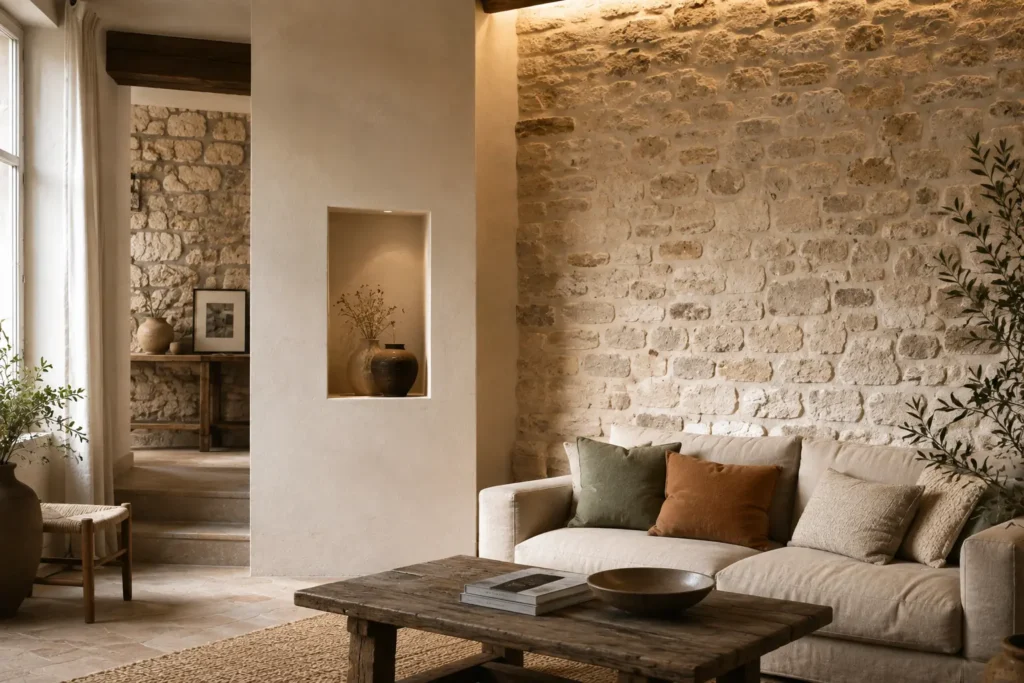
You can keep a single stone wall in the living room, reveal an old fireplace, or simply let a few architectural features show through. The other surfaces can then be finished with a suitable plaster, creating a much more subtle contrast.
This approach allows us to preserve the soul of the building without transforming the entire house into an old farmhouse setting.
Lime, a natural ally for old walls
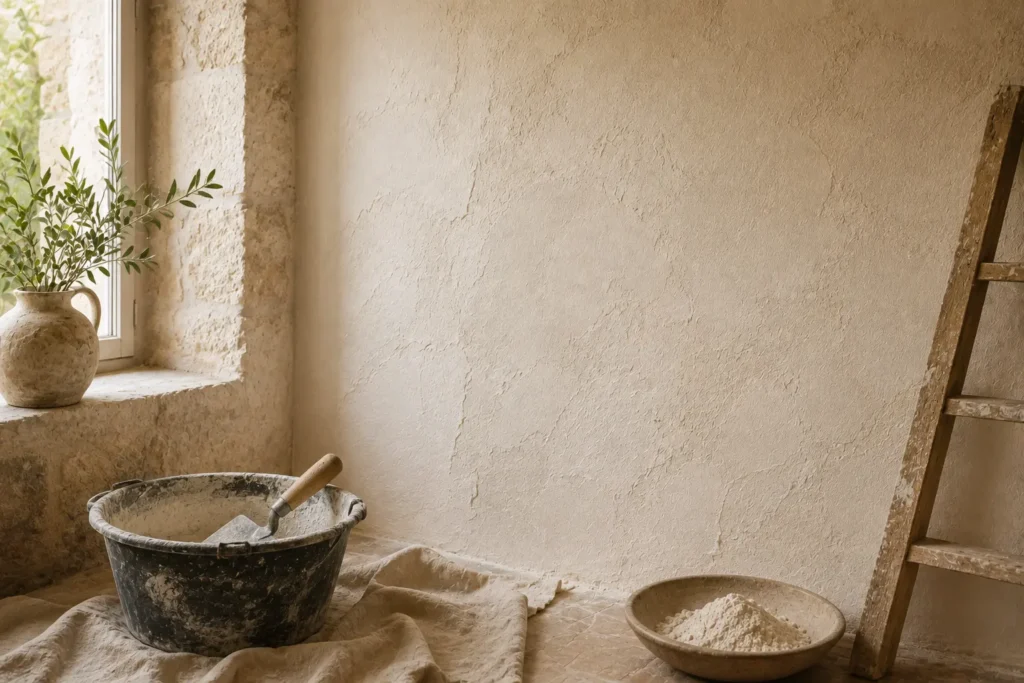
If there is one material that seems almost inseparable from traditional renovation, it is probably lime.
Used for centuries, it is particularly well-suited to many old surfaces when chosen and applied correctly. Unlike some very opaque finishes, a suitable lime-based plaster can, in particular, allow water vapor to exchange through the wall.
But its appeal is also aesthetic.
A lime finish is never perfectly uniform. Light plays on the material, revealing nuances that evolve throughout the day. It is precisely this imperfection that I find so interesting.
In an old house, striving for perfectly smooth walls can sometimes diminish the building's charm. A slightly textured finish, on the other hand, embraces its history.
However, the type of lime and the composition of the plaster must be chosen according to the substrate. If in doubt, especially when faced with moisture problems, it is best to seek advice from a craftsman who is truly familiar with old buildings.
Wood: preserving the marks of time
Beams, floors, doors, stairs… wood is often omnipresent in old houses.
And again, renovating does not necessarily mean replacing.
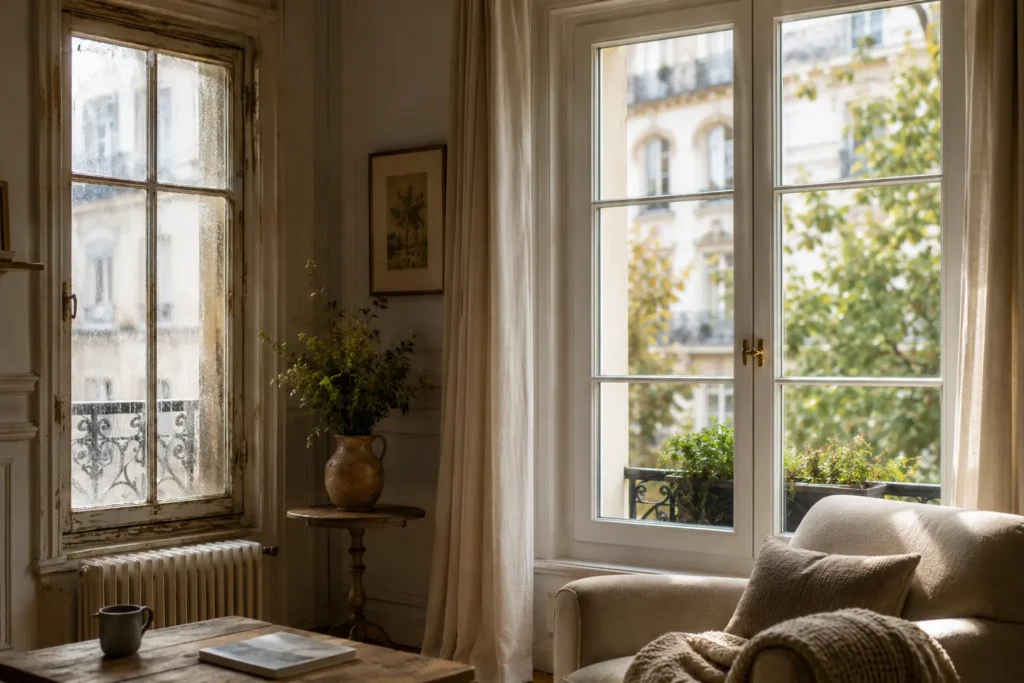
An old, scratched, or slightly uneven floor can regain a great deal of character after proper sanding and a new finish. An old door can become a true decorative feature once stripped of several layers of paint.
I particularly like finishes that still allow the wood grain to show through: oils, waxes or matte finishes depending on the uses and constraints of the room.
The result doesn't need to look new.
A small mark, a variation in shade, or an old repair can, on the contrary, tell a story. In a contemporary interior, these patinated elements bring a depth that a perfectly standardized material sometimes struggles to reproduce.
Terracotta and natural stone for floors that age well
The floor greatly influences our perception of a house.
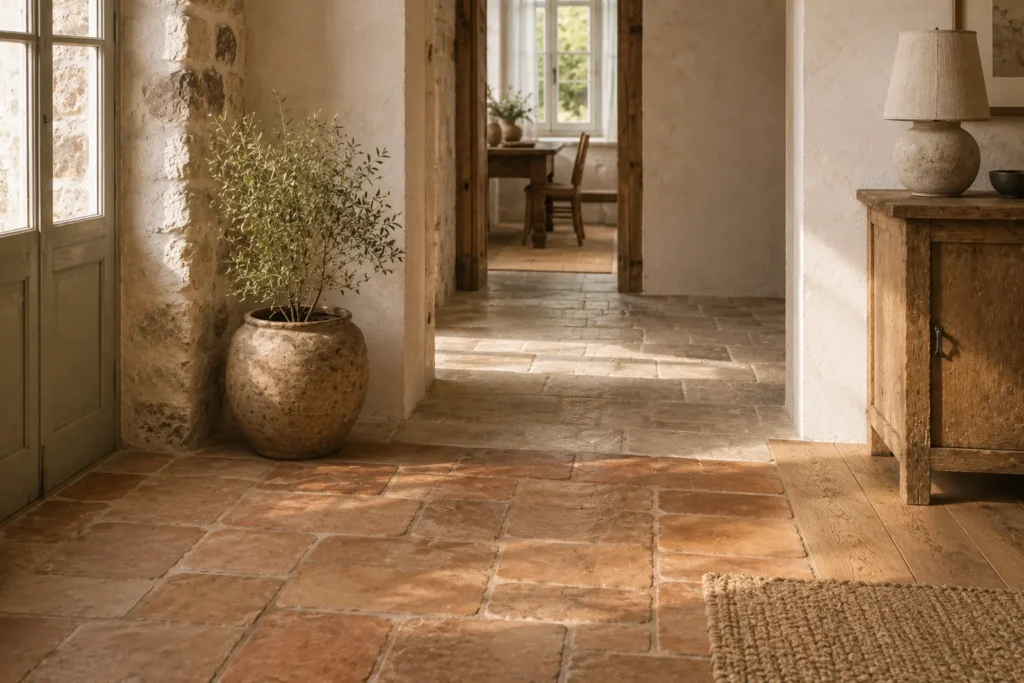
In older buildings, terracotta tiles and other earthenware tiles always deserve to be examined before considering their replacement.
Even when stained or dull, some old floors can be restored with proper cleaning and treatment. Their irregularities and variations in shade then become integral to the room's atmosphere.
When the existing floor really needs to be replaced, natural stone, terracotta or wooden parquet flooring are particularly suitable options.
The goal is not necessarily to reproduce exactly what would have been installed two centuries earlier. Rather, it is about choosing a material capable of interacting with the existing architecture.
Insulating an old house without forgetting how it works
This is probably one of the most sensitive subjects.
We naturally want to make our homes more comfortable and reduce their energy needs. But an old building wasn't always designed according to the same principles as a contemporary building.
Its walls, floors and ventilation system function as a whole.
Adding insulation or cladding without considering this balance can sometimes shift the problems rather than solve them, especially when moisture is already present.
Before undertaking any major work, it is therefore essential to identify the source of any leaks, rising damp, or condensation. A precise diagnosis then allows for the selection of materials that are compatible with the building's actual function, rather than simply masking the symptoms.
To delve deeper into these technical questions surrounding buildings, their maintenance, and various renovation solutions, you can also discover more details through features dedicated to the home, renovations and the preservation of housing.
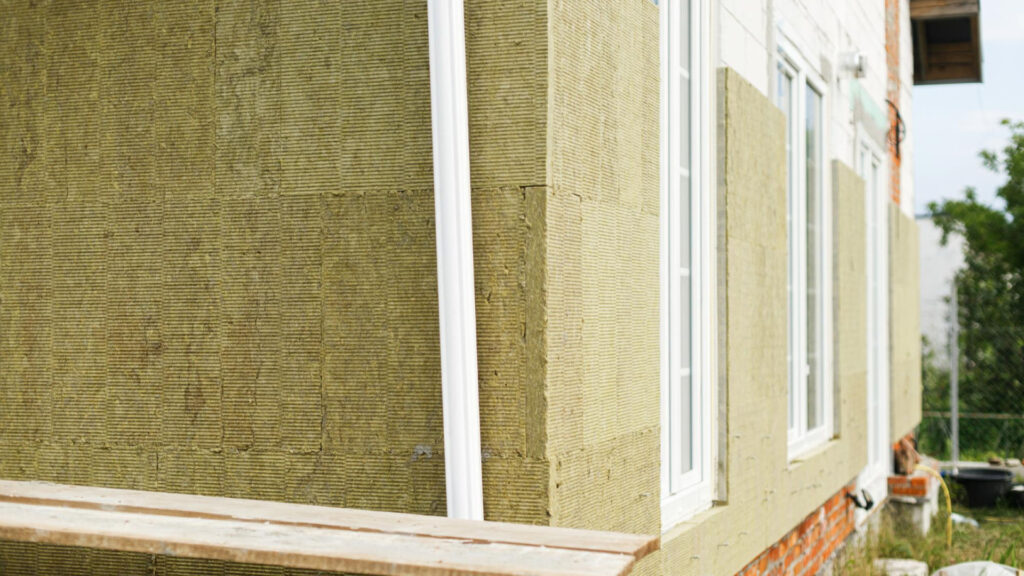
Once the diagnosis has been made, several materials can be considered depending on the configuration: wood fiber, cork, cellulose wadding, hemp or even certain thermal correction coatings.
The ideal material does not exist. What matters is the consistency between the wall, the insulation, the finishes and the moisture management.
Natural materials, but not just because they are natural
Wood, hemp, lime, cork, clay… when you love old houses and warm interiors, these materials inevitably have something appealing about them.
But I am always a little wary of an overly simplistic idea: natural does not automatically mean adapted.
A material can be bio-based and yet unsuitable for a humid room. A traditional finish can be beautiful but require maintenance incompatible with our daily lives.
The choice should therefore always begin with the intended use.
| For… | One could consider, in particular… |
|---|---|
| Restoring an old wall | Lime plaster suitable for the substrate |
| Bringing heat to the ground | Wooden or terracotta parquet flooring |
| Insulate certain walls | Wood fiber, cork or hemp depending on the configuration |
| Create a very matte finish | Clay or mineral paint |
| Preserve an old item | Cleaning, repairing and restoring rather than replacing |
These guidelines are obviously not universal rules. Each house has its own constraints and deserves to be observed before making a decision.
Mixing old and new rather than recreating the past
Renovating an old house does not mean living in a museum.
On the contrary, I often find interiors most interesting when they create a dialogue between different eras.
Imagine a slightly uneven whitewashed wall behind a large, contemporary table. Antique parquet flooring complements a minimalist kitchen. A few preserved terracotta tiles stand opposite a light wood cabinet. An old beam hangs above a modern sofa.
It is precisely this contrast that gives the whole thing its personality.
Rather than trying to reproduce a historical style down to the smallest detail, it is better to keep a few strong elements and build the decoration around them.
Natural materials particularly facilitate this dialogue: wood, linen, stone, ceramics, rattan or plant fibers transcend eras without really belonging to a specific trend.
Reuse before replacing
This is perhaps the reflex I would most like to retain during a renovation.
Before throwing away a door, a parquet floor, a beam or even some tiles, let's ask ourselves if they can be repaired, moved or transformed.
An old door can become a sliding door. Terracotta tiles salvaged from a room can be used to create a small area in front of a fireplace. Old planks can be transformed into shelves or a tabletop.
This approach obviously helps to reduce certain types of waste, but it also has an aesthetic appeal.
By reusing elements from the house, we maintain a common thread between its history and its new life.
Accepting that an old house will never become perfectly new
This is probably one of the best things to accept when renovating.
The walls may never be perfectly straight. The floorboards will sometimes still creak. A beam will retain an old crack. The stones in a single wall will not all be exactly the same color.
And ultimately, is it really a problem?
It is precisely these small irregularities that distinguish an old house from a building that was erected a few months earlier.
A successful renovation therefore does not necessarily consist of removing all traces of the past. Rather, it consists of determining which ones we want to preserve.
By choosing materials compatible with the building, restoring where possible and introducing contemporary elements in moderation, we can create much more comfortable homes without taking away what makes them unique.
And perhaps that's the crux of the matter: not to renovate against the house, but to renovate with it.